

As digital assets become more deeply integrated into the global financial system, the “single point of failure” found in traditional wallets has surfaced as a major vulnerability. In a standard setup, one private key provides total control over the funds. If that key is stolen, lost, or misused by an employee, the assets are gone—instantly and permanently.
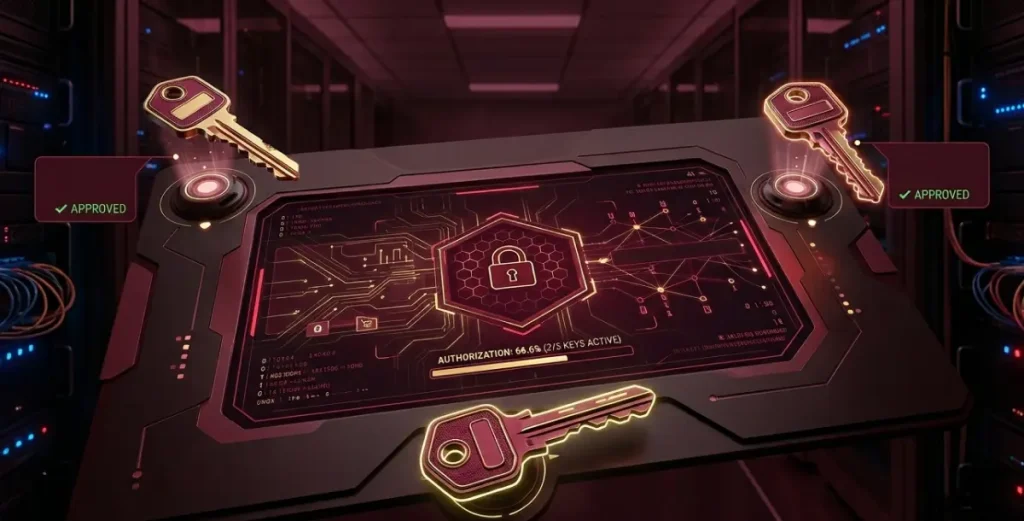
To solve this, multi-signature (multi-sig) technology has become the bedrock of institutional security. Instead of relying on one person, multi-sig requires multiple independent approvals to move any money, replacing individual risk with a “joint-approval” system. This approach is now the standard for corporate treasuries, exchange storage, and professional governance.
Understanding the Multi-Sig Mechanism
Multi-sig is a cryptographic arrangement that requires M-of-N private keys to authorize a blockchain transaction. Unlike a standard wallet where one key opens the vault, a multi-sig wallet acts as a digital safe with multiple locks, each requiring a different key.
The Limitations of Single-Signature Wallets
Standard wallets operate on a 1-to-1 ratio:
- Single Key = Absolute Control: Total dependence on one string of data.
- No Recovery Path: Loss of the key equals permanent loss of capital.
- Insider Risk: No technical barrier prevents a single employee from misappropriating funds.
How Multi-Sig Works
Multi-sig implements a mandatory approval threshold for all transactions. Common configurations include:
- 2-of-3: Three stakeholders hold keys; any two must sign to move funds. Ideal for small teams or family offices.
- 3-of-5: Five designated signers; a majority of three is required for execution. Standard for mid-sized institutional funds.
- 5-of-7 or Higher: Reserved for high-security enterprise environments or sovereign-grade custody.
This structure ensures that the compromise of a single device or the absence of one key-holder does not paralyze operations or lead to theft.
Strategic Advantages of Multi-Sig
The adoption of multi-sig provides several layers of protection essential for B2B operations:
- Decentralized Authority: Assets are governed by a committee rather than an individual, aligning blockchain management with traditional corporate governance and fiduciary duties.
- Preventing Private Key Compromise: Even if an attacker successfully hacks one administrator’s laptop, they cannot move funds without simultaneous access to the other required signatories.
- Error Prevention: The multi-party review process acts as a natural buffer against operational mistakes, such as sending funds to an incorrect address or inputting the wrong transaction amount.
- Customizable Governance: Organizations can tailor their signature thresholds based on the risk profile of specific asset pools (e.g., lower thresholds for operational hot wallets, higher for long-term reserves).
Core Institutional Applications
Multi-sig technology provides the foundational security for several high-stakes digital asset operations:
1. Corporate Treasury Management
Enterprises leverage multi-sig to integrate blockchain-based assets into established financial workflows. By distributing authorization across key roles—such as the CFO, a risk officer, and an external auditor—firms ensure that every capital movement is verified, compliant, and subject to internal oversight.
2. Exchange Cold Storage
Centralized exchanges (CEXs) secure the vast majority of user funds in “cold” (offline) environments. Multi-sig provides a critical layer of security, ensuring that physical access to a single offline device is never enough to compromise the exchange’s reserves.
3. DAO and Ecosystem Governance
Decentralized Autonomous Organizations (DAOs) utilize multi-sig to manage community treasuries. Community-elected “guardians” or core contributors hold the signing power, ensuring that funds are only deployed in strict accordance with the results of community votes.
4. Institutional Custody
Professional custodians employ multi-sig to offer bankruptcy-remote and multi-party security. This framework reassures investors that their assets are shielded from the vulnerabilities or internal decisions of any single service provider.
Comparative Analysis of Management Solutions
| Feature | Single-Signature | Multi-Signature | Centralized Custody |
| Security Level | Low | High | Medium |
| Decentralization | High | High | Low |
| Operational Ease | High | Medium | High |
| Target Audience | Retail Users | Institutions/DAOs | Beginners |
Technical Implementation and Governance
Multi-sig is typically implemented through two primary methods:
- On-Chain Smart Contracts: Popular on EVM chains (e.g., Safe), where the logic for the M-of-N requirement is written directly into a smart contract. This provides maximum transparency but incurs higher gas costs.
- Protocol-Level Multi-sig: Built into the native code of certain blockchains (like Bitcoin), where the network itself validates multiple signatures before a transaction is considered valid.
Challenges and the Future Outlook
Despite its strengths, multi-sig presents certain operational challenges:
- Coordination Latency: Requiring multiple people to sign can slow down time-sensitive transactions.
- Increased Transaction Costs: More signatures result in more data on-chain, leading to higher network fees.
The Strategic Shift in Digital Asset Risk Management
As the scale of digital asset holdings continues to expand, the “single-key” model has become an obsolete relic of the past—it is simply no longer a viable option for professional entities. We are now entering a new era defined by a hybrid custodial model, where the institutional governance of Multi-Sig is seamlessly integrated with the advanced cryptographic execution of Multi-Party Computation (MPC). This combination provides the best of both worlds: the clear, auditable transparency of multi-sig and the superior privacy and efficiency of MPC.
Ultimately, the adoption of multi-signature technology represents more than just a technical upgrade; it is a fundamental shift in risk management philosophy. By distributing authorization across multiple parties, institutions can finally achieve a security posture that meets the rigorous standards of modern global finance. This framework ensures that digital assets remain shielded against the dual threats of external cyberattacks and internal operational failures, providing the robust foundation necessary for long-term institutional growth.