


- Multi-Party Computation (MPC) does not generate a single private key and slice it up afterward. Instead, multiple independent parties jointly compute keys and signatures without ever revealing their private inputs or assembling a master key string.
- Security controls must govern key share creation, active signing sessions, policy changes, emergency recovery, and vendor offboarding.
- High-value or anomalous transactions must require dual-control verification, keeping maximum potential loss capped within predefined limits.
When on-chain operations transition from occasional transfers to active daily management, a crypto wallet ceases to be a simple personal tool and becomes core digital asset governance infrastructure.
The vast majority of institutional capital losses do not stem from underlying cryptographic breaks; they are caused by over-concentrated permissions, unverified recovery pathways, or operators signing transaction payloads they do not fully understand.
This guide evaluates multi-party computation (MPC) wallets, its underlying technology, and private key management mechanics to explain how keys are generated, co-signed, and recovered safely across enterprise workflows.
Separating the App Dashboard from Cryptographic Signing
Before looking at how Multi-Party Computation functions under the hood, technical teams must separate the software interface from the cryptographic engine:
- Management Dashboard: Where administrators log in, monitor balances, and initiate payout requests.
- Policy Verification Engine: Where automated rules evaluate daily limits, approval hierarchies, and address whitelists off-chain.
- MPC Signing Engine: Where distributed nodes compute partial signature fragments using their isolated key shares.
- Public Blockchain Ledger: Where the final, compiled signature broadcasts to move funds permanently.
In a true MPC wallet architecture, logging into a web dashboard never gives a user direct access to private key material. Understanding this separation is essential for evaluating how MPC achieves mathematically proven security without exposing a master key.
The Core Problem Solved by Multi-Party Computation
Multi-party computation (MPC) technology allows independent nodes to jointly compute a function output using their private inputs without ever revealing those inputs to one another.
In a wallet context, the objective is to produce a valid digital signature on-chain without allowing a complete private key to exist on any single device, in system memory, or over a network channel at any point in its lifecycle.
When implementing MPC, connect input parameters, approval evidence, execution logs, and post-trade reconciliation into an unbroken chain. Any un-auditable exception will turn into a long-term vulnerability as your operations scale.
Distributed Key Generation (DKG): How Key Shares Are Created
Secure MPC implementations use Distributed Key Generation (DKG) protocols. Each participating node independently generates a random mathematical secret and exchanges protected cryptographic messages with the other nodes.
The protocol calculates a single public key and assigns individual key shares to each participant. Because a complete private key never exists at initialization, an attacker compromising a setup node cannot extract a master secret.
Balance security controls against team usability. Overly restrictive controls lead staff to bypass approval steps or share credentials, while loose controls increase threat exposure. Validate setups using small capital allocations before attempting full portfolio migrations.
Why an Individual Key Share Cannot Authorize Transactions
A single key share contains only partial mathematical data and cannot generate a valid blockchain signature on its own.
To clear a transaction, a pre-set threshold of participating nodes must run a multi-round signature protocol using the transaction payload, temporary randomness (nonces), and their isolated key shares. The output is a standard signature (such as ECDSA or EdDSA) that broadcasts natively to public ledgers. On-chain validators see only a standard public key and a single signature, keeping your internal approval structure and node layout completely private off-chain.
Balancing Security and Availability via Threshold Structures
Choosing a Threshold Signature Scheme (TSS) quorum requires balancing capital defense against operational availability:
- Lower Thresholds (e.g., 2-of-3): Enhance operational continuity if a key share is lost or temporarily unavailable, but slightly increase the risk if a minority of nodes are compromised.
- Higher Thresholds (e.g., 3-of-5): Require broader organizational consensus for high-value payouts, but risk operational delays if keyholders are offline.
Update operational documentation and staff training in tandem. Ensure team members understand why restrictions exist, while double-checking workflows, maintaining independent logs, and running regular recovery drills.
Pre-Signature Processing and Real-Time Execution
To reduce latency during live transaction clearing, many modern MPC protocols pre-compute non-transaction-specific mathematical parameters offline.
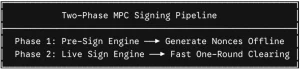
These pre-signature materials hold high cryptographic value. They must be protected against reuse, data leaks, and state desynchronization. Implementations must guarantee unique session identifiers and handle unexpected network disruptions or retry requests gracefully.
Reducing Long-Term Risk Through Key Share Refreshing
Without changing your public blockchain address or migrating funds on-chain, an MPC wallet can run a Proactive Key Refresh (DKG) protocol off-chain.
This re-randomizes all key shares, making legacy key shares mathematically useless. Even if an attacker collects stolen key shares over extended periods, those old shards cannot be combined with new ones to move funds.
Keep in mind that key share refreshing reduces long-term exposure, but it does not replace routine endpoint cleaning and security reviews.
Designing Account Recovery Without Recreating Single Points of Failure
Account recovery in an MPC wallet can introduce backup enclaves, cloud factors, or secondary signers, but the core objective remains unchanged: never allow a full private key to be compiled in a single place.
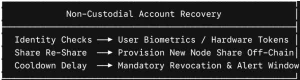
Separating identity verification, key share redistribution, and new device registration prevents recovery paths from becoming backdoor attack vectors. Enforce mandatory cooling-off delays, automated security alerts, and manual compliance checks for all emergency recovery events.
Evaluating Vendors Beyond Marketing Buzzwords
Having an “MPC” label on a product does not guarantee enterprise-grade security. A complete security evaluation must inspect the entire engineering stack:
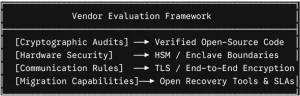
Formal cryptography names cannot replace full security engineering. Evaluate real transaction volumes, staff bandwidth, and target recovery time objectives (RTO) through staged, low-value tests before committing major capital.
Understanding Multi-Party Computation at a cryptographic level removes the guesswork from wallet security. By ensuring that a master private key is never compiled in memory—from initial key generation through daily transaction signing—MPC eliminates single-point vulnerabilities without sacrificing settlement speed. For technical teams, selecting an MPC wallet comes down to inspecting the underlying DKG protocols, pre-signature mechanics, and key share refresh capabilities to build a resilient, multi-node signing stack.
Frequently Asked Questions (FAQs)
Can an MPC wallet guarantee absolute protection against all cyber attacks?
No. While MPC eliminates single points of failure at the private key layer, no technical architecture can eliminate all risks—including sophisticated phishing, coordinated insider collusion, software bugs, or physical disasters. The objective is eliminating single points of failure, capping maximum potential losses, flagging anomalies early, and ensuring auditable recovery pathways.
Where should an enterprise start when deploying an MPC wallet setup?
Begin with a comprehensive asset and permission inventory. Map out every capital bucket’s utility, peak balances, transaction frequency, authorized roles, and recovery parameters. Next, run low-value tests to validate approval workflows, key signing execution, ledger reconciliation, and backup recoveries before scaling up portfolio allocations.
How frequently should MPC key shares and permission rules be audited?
Audit access permissions, address whitelists, backup integrity, and active key shares at least quarterly. Execute immediate reviews following any employee turnover, device rotation, protocol upgrade, or anomalous security alert. Conduct full emergency recovery simulations annually.
Spotlight: Institutional MPC Infrastructure Powered by ChainUp
For technical teams and digital asset platforms seeking a proven MPC-TSS engine, ChainUp Custody provides an institutional framework. The platform leverages advanced Threshold Signature Schemes (TSS) and Distributed Key Generation (DKG) across 200+ mainnet blockchains, ensuring key shares are computed off-chain and never compiled in server memory. Supported by SOC 2 Type I & II and ISO 27001 certifications, ChainUp Custody gives developers and treasury managers mathematically proven key security with high-concurrency performance.
👉 Discover More: ChainUp Custody Official Portal