

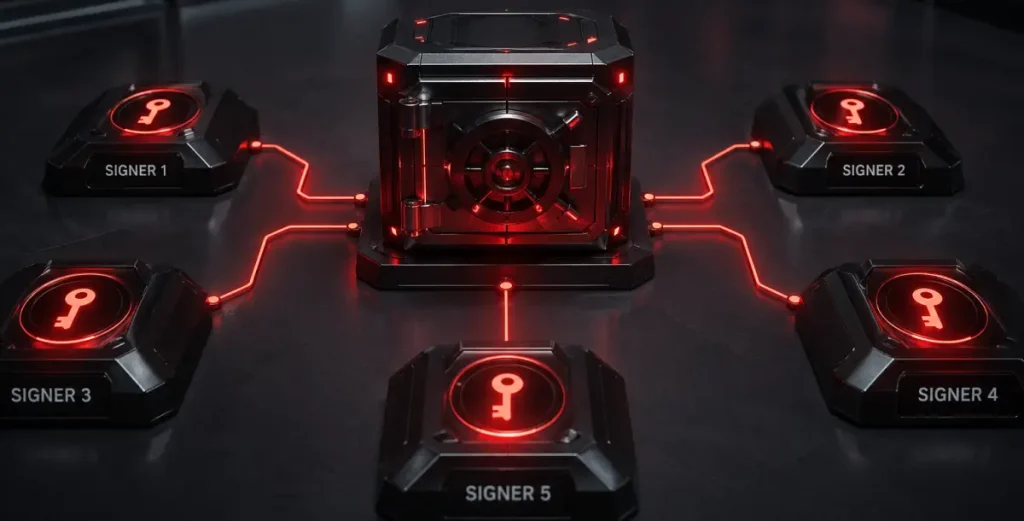
As the digital asset ecosystem matures, security and regulatory compliance have emerged as the dual pillars of institutional adoption. Cryptocurrency custody and multi-signature (Multi-Sig) technology are no longer separate concepts; they have merged into a single “gold standard” for modern asset protection.
For institutional investors, exchange operators, and corporate treasuries, integrating Multi-Sig into a custodial framework is the most effective way to eliminate single points of failure while streamlining internal governance. This article explores the synergy between custody and Multi-Sig, breaking down their technical architecture, strategic value, and real-world applications.
Defining the Core Components
1. Cryptocurrency Custody
In an institutional setting, cryptocurrency custody is more than just storage. It is a comprehensive operational and technical framework built to secure private keys. It covers the entire asset management lifecycle, from authorizing transfers and real-time risk monitoring to providing full, auditable reporting.
2. Multi-Signature (Multi-Sig) Technology
Multi-Sig is a protocol that requires multiple independent private keys to authorize a single blockchain transaction. Instead of relying on a single “master key,” control is distributed across a set of keys. Common configurations include:
- 2-of-3: Any two out of three authorized keys must sign to execute a transaction.
- 3-of-5: At least three out of five keys are required, typically used for higher-security environments.
Why Institutional Custody Demands Multi-Sig
In a traditional single-signature environment, the private key is a significant liability. If it is compromised, lost, or misused by an insider threat, the assets are permanently unrecoverable. Multi-Sig frameworks mitigate these risks through:
- Eliminating Single Points of Failure: No single individual or server has the authority to move funds unilaterally.
- Strengthening Attack Deterrence: To compromise assets, an external attacker would need to breach several independent environments simultaneously—an exponentially more difficult feat than targeting a single key.
- Enforcing Institutional Governance: Multi-Sig effectively encodes corporate hierarchy into the protocol. Transactions can be programmed to require sign-off from specific stakeholders—such as the CFO, a compliance officer, and a technical lead—ensuring every movement strictly adheres to internal policy.
Technical Workflow: How Multi-Sig Custody Operates
A robust Multi-Sig custody system follows a rigorous, non-linear path to transaction finality:
- Initiation: An authorized user creates a transaction request (e.g., a transfer to a cold wallet).
- Notification: The custody engine identifies the required signers based on pre-set logic and sends secure notifications to each party.
- Independent Verification: Each signer reviews the transaction details—such as destination address and amount—on their independent device and provides a cryptographic signature.
- Threshold Aggregation: Once the pre-defined threshold (e.g., 3 signatures) is met, the system aggregates the signatures and broadcasts the transaction to the blockchain.
- Immutable Logging: The entire process is recorded in an audit log, documenting exactly who authorized the movement of funds and when.
Core Roles of Multi-Sig in Custody Systems
Risk Isolation
By distributing keys across different physical locations or distinct organizational roles (e.g., Executive Management vs. Cybersecurity Teams), organizations create strategic “air gaps.” This ensures that a localized breach does not escalate into a total loss of assets.
Mitigating Internal Collusion
Internal fraud remains a primary threat to digital asset security. Multi-Sig enforces a “multi-party check” on every transaction, making it virtually impossible for a single bad actor to misappropriate funds without detection or authorization from others.
Regulatory and Audit Readiness
Multi-Sig provides a transparent, immutable record of decentralized decision-making. This level of visibility is indispensable for institutions needing to satisfy the rigorous reporting and compliance standards of global financial regulators.
Common Institutional Multi-Sig Configurations
- Intra-Corporate Multi-Sig: Keys are distributed among internal departments (Finance, Risk, Executive Management).
- Client-Custodian Co-Signing: The client holds one key and the professional custodian holds two. This “Hybrid Custody” ensures the custodian cannot move funds without client consent, while also providing a recovery path if the client loses their key.
- Multi-Institutional Custody: For ultra-high-value assets, keys may be split among multiple independent legal entities to achieve distributed trust.
Strategic Challenges and Mitigations
While Multi-Sig provides industry-leading security, it does introduce specific operational overhead that requires careful management:
- Operational Latency Coordinating multiple signatories can extend transaction lead times.
- Mitigation: Deploy automated notification engines and mobile-integrated signing applications to accelerate approval workflows.
- Key Management Complexity Overseeing a distributed key set is inherently more demanding than managing a single private key.
- Mitigation: Implement enterprise-grade Key Management Systems (KMS) featuring automated backup and standardized recovery protocols.
- Increased Network Costs On certain blockchains, Multi-Sig transactions require more data, leading to higher gas fees.
- Mitigation: Leverage Layer 2 scaling solutions or Multi-Party Computation (MPC) to minimize the on-chain footprint and reduce costs.
The Future of Secure Custody: Toward Programmable Resilience
The industry is currently gravitating toward a fusion of Multi-Sig and Multi-Party Computation (MPC). While Multi-Sig operates as an on-chain protocol, MPC enables the “mathematical” sharding of a single key, offering superior flexibility and privacy.
Looking ahead, we anticipate the rise of Programmable Governance. This will allow smart contracts to dynamically adjust Multi-Sig thresholds based on transaction volume—for example, requiring two signatures for routine operational transfers while escalating to five signatures for significant treasury movements.
Building the Foundation for Digital Leadership
The integration of Multi-Sig into custodial frameworks represents a fundamental shift from individual trust to systemic security. It serves as the cornerstone of a “Zero Trust” architecture, ensuring that digital assets are protected by rigorous cryptographic logic rather than human fallibility. By decentralizing control, organizations do more than just secure their capital—they establish the institutional-grade infrastructure necessary to scale within the global digital economy.