


Key Takeaway
- The value of multi-signature (multi-sig) technology extends far beyond requiring multiple clicks. It structurally embeds power decentralization, segregation of duties, and disaster recovery directly into on-chain asset controls.
- Security mechanisms must govern every phase of the custody lifecycle—creation, daily execution, permission changes, disaster recovery, and key deprovisioning.
- Every critical asset movement must undergo independent human and policy checks, keeping potential capital loss strictly capped within predetermined limits.
When on-chain operations shift from occasional transfers into continuous corporate operations, a crypto wallet ceases to be a simple personal tool and becomes foundational digital asset governance infrastructure.
The vast majority of institutional capital security incidents do not stem from cryptographic breaks. Instead, they occur because of over-concentrated permissions, untested recovery mechanisms, or signing operators approving transaction payloads they cannot accurately read or verify.
This guide evaluates various architectures to help organizations translate traditional corporate finance approval hierarchies into transparent, verifiable on-chain execution rules.
Delineating the Approval Layer from On-Chain Clearance
When implementing multi signature frameworks in asset custody, organizations must clearly decouple business verification from cryptographic clearance:
- Off-Chain Verification: Where finance teams review invoices, contracts, and counterparty authenticity before any signature is generated.
- Policy & Threshold Check: Where pre-configured rules evaluate required signers based on transaction value, operational hours, and destination whitelists.
- Multi-Sig Signing: Where independent keyholders visually inspect transaction hashes and apply their isolated signature shares.
- Ledger Settlement: The public blockchain state where the compiled M-of-N smart contract or native threshold unlocks and broadcasts funds.
A web dashboard approval does not equal a cryptographic signature, and an off-chain manager sign-off cannot move funds on-chain. Establishing explicit operational boundaries between these layers ensures your financial controls map accurately onto public ledger rules.
Structural Advantage: Eliminating Single-Point Risks
In a traditional single-signature setup, holding one private key grants absolute control over funds. The threat surface is concentrated on a single employee device, seed phrase, or administrator credential.
Multi sig fundamentally alters this model by deploying an M-of-N threshold rule natively on-chain or via smart contract logic (e.g., requiring 3 signatures out of 5 designated keyholders).
Even if an attacker breaches a signing endpoint or phishes a keyholder, they cannot move funds unilaterally. This structural defense neutralizes single points of failure, protecting corporate treasuries against both external endpoint attacks and isolated internal rogue actions.
Calibrating Signer Profiles and Threshold Dynamics
Designing an effective multi signature policy requires balancing operational velocity with collusion defense:
- Threshold Too Low (e.g., 2-of-5): Speeds up routine transfers but lowers the barrier for internal collusion or credential theft.
- Threshold Too High (e.g., 5-of-5): Maximizes security consensus, but creates severe operational deadlocks if a single keyholder travels, loses a device, or falls ill.
When setting threshold rules, factor in daily transaction frequency, team geographical distribution, department independence, and emergency signer redundancy rather than simply picking the highest number.
Mapping Corporate Roles Directly to Signing Keys
To prevent internal power concentration, on-chain key roles must reflect real-world segregation of duties. Key permissions belong to organizational roles—not individual employee identities as permanent personal property:
Role-Based Key Segregation
- Keyholder 1 (Finance Clerk): Initiates Outbound Payout
- Keyholder 2 (Risk Officer): Verifies Invoice & KYT
- Keyholder 3 (Treasury Manager): Grants Final Co-Sign
Avoid placing keys with direct reporting lines on the same physical device or within the same office location. When an employee changes roles or leaves the organization, their associated key must be revoked, and the signer set re-configured through an on-chain key rotation event.
Bridging On-Chain Multi-Sig with Off-Chain Financial Verification
A common misconception is that deploying multi sig replaces traditional corporate financial auditing. In reality, on-chain smart contracts only verify that M valid signatures were collected—they cannot automatically verify whether an invoice is genuine, whether a vendor address was altered, or whether a contract was signed.
Before initiating an on-chain signing sequence, finance teams must complete off-chain verification, linking internal payment tickets and invoice IDs directly to the transaction payload. Technical signing layers and corporate accounting policies must operate as a closed, fully auditable loop.
Ensuring Business Continuity Through Signer Redundancy
Keyholder vacations, damaged hardware tokens, or regional internet disruptions can freeze business operations if signer redundancy is omitted from the initial architecture design.
A resilient asset custody strategy maintains alternate keyholders without lowering safety parameters:
Signer Redundancy & Continuity Plan
- Active Signers: 3-of-5 Quorum (Daily Operations)
- Designated Backup: Alternate Keyholder Activated via Timelock or Emergency Governance
Define explicit activation rules for backup signers, run scheduled keyholder drills, and monitor alternate endpoint health. Redundancy shouldn’t lower signing thresholds—it should ensure that operations continue smoothly when primary signers are temporarily unavailable.
Managing Key Rotation and Team Onboarding/Offboarding
When staff departures occur, roles change, or an endpoint is suspected of compromise, key rotation protocols must execute immediately.
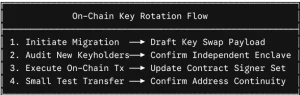
Depending on whether the wallet uses native protocol multi-sig or smart contract architecture (such as Safe), updating signers may require deploying a new contract address or executing an on-chain contract state update. Always run small-value test transactions, verify balance accounting, and maintain monitoring over legacy addresses during migration.
Looking Beyond Search Keywords to Core Security Realities
While users frequently search for terms like multi sig, multi signature, or common typos like mutli sig, evaluating a wallet solution requires looking past marketing labels.
Focus on the physical and cryptographic reality of key isolation:
- Are keys generated on completely independent, isolated devices?
- Can signing operators visually inspect and human-read the raw transaction parameters (destination address, token value, network fee) on a secure display before signing?
- Are threshold rule modifications protected by strict time-locks and mandatory multi-user approval?
Designing the Physical Signing Ritual for High-Value Transactions
For low-frequency, high-value treasury movements, organizations should transform key signing into a formal, structured ceremony:
- Pre-Sign Presentation: Before any hardware is connected, a compliance recorder presents the raw transaction payload, destination address proof, and matching purchase order.
- Independent Payload Verification: Each signer verifies the exact transaction hash on an isolated, air-gapped device screen.
- Isolated Signing Execution: Signers apply their approvals using independent hardware tokens. If any transaction parameter changes, the ceremony is aborted and restarted from scratch.
- Audit Archiving: The recorder logs the transaction hash, participant list, device IDs, and broadcast confirmation, storing the record for internal and external auditors without collecting private key material.
This structured procedure converts abstract threshold math into an auditable corporate decision-making process.
Turning Threshold Math into Accountable Corporate Governance
Adopting a multi-signature architecture is less about adding technical friction to transfers and more about embedding institutional governance directly into public ledger execution. By distributing signing authority across independent roles and enforcing strict off-chain financial verification before transactions reach the blockchain, organizations eliminate single-point vulnerabilities without sacrificing operational continuity. A well-designed multi-sig framework transforms on-chain asset movements from opaque, single-person decisions into structured, fully auditable corporate actions.
Spotlight: Institutional-Grade Architecture Powered by ChainUp Custody
For organizations looking to deploy an enterprise custody stack that aligns with this decision framework, ChainUp 托管 provides an institutional platform.
The platform utilizes a secure, non-custodial Multi-Party Computation (MPC) architecture to eliminate single points of failure. By deploying 门限签名方案(TSS), ChainUp Custody ensures key shares are co-computed off-chain and never compiled in memory, delivering mathematically proven capital protection alongside fast settlement velocity.
Simultaneously, the platform embeds a programmable policy engine that enables corporate risk managers to set up custom approval workflows, role-based access controls (RBAC), destination address whitelists, and automated volume caps. Backed by authoritative international credentials—including SOC 2 Type I & Type II, ISO/IEC 27001, ISO 27017, and ISO 27018—ChainUp Custody provides a compliant environment for institutional digital asset management.
👉 Discover More: ChainUp 托管 Technical Specifications
Frequently Asked Questions (FAQs)
What is the key operational difference between Multi-Sig and MPC?
Multi-Sig operates on-chain (typically via smart contracts like Safe or native blockchain protocol rules), making every signing address and approval threshold visible on public block explorers. MPC operates off-chain at the cryptographic key-generation layer, aggregating partial key shares into a single standard signature before broadcasting to the network. Multi-sig provides transparent, smart-contract-enforced approval logic, whereas MPC offers gas efficiency and hides internal signing structures from public view.
Can an internal rogue actor bypass a multi-sig policy?
Not unilaterally. In an M-of-N multi-sig setup, no single employee or compromised endpoint possesses sufficient authority to move funds. To execute an unauthorized transfer, an internal actor would need to collude with or compromise a full quorum of independent keyholders across separate reporting lines, making insider theft significantly harder to carry out unnoticed.
What happens if an M-of-N keyholder leaves the company unexpectedly?
Your treasury team should execute an on-chain key rotation transaction immediately. Using the remaining active signers to meet the current threshold, the contract’s signer list is updated to revoke the former employee’s key address and register a newly provisioned keyholder. This updates execution permissions on-chain without requiring assets to be manually transferred to a brand-new wallet address.