

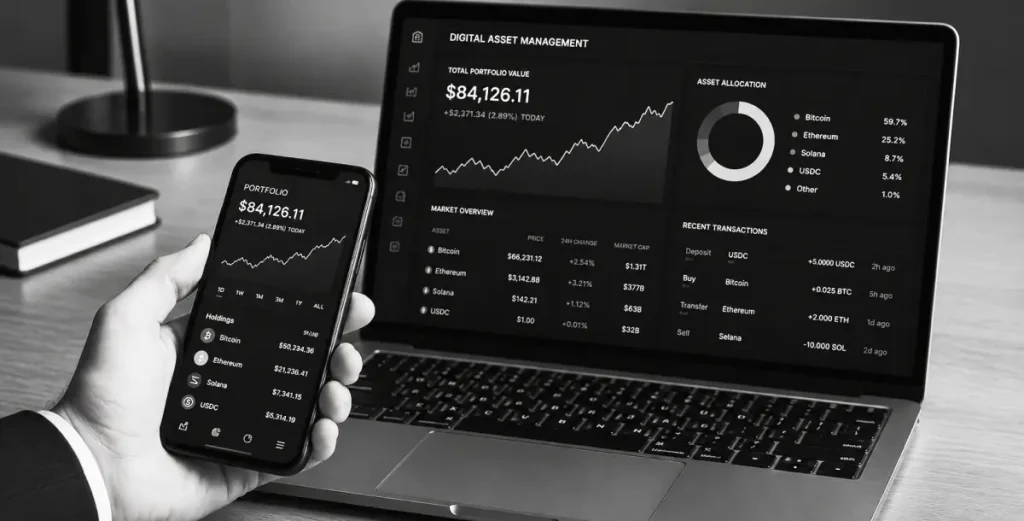
In the sophisticated hierarchy of digital asset storage, security is often viewed as a spectrum. At one end lies the Hot Wallet, optimized for speed and frequent use; at the other is the Cold Wallet, designed for maximum isolation and long-term storage. Between these two extremes lies the Warm Wallet—a strategic middle ground adopted by institutions and professional investors to balance operational agility with institutional-grade security.
A warm wallet is more than just a storage type; it is a functional buffer layer that ensures capital can move efficiently without being exposed to the high-risk environment of a purely online wallet.
The Operational Middle Layer: Defining the Warm Tier
A warm wallet is a digital asset storage solution that maintains a controlled, limited connection to the internet. Unlike cold wallets, which are completely air-gapped, a warm wallet is “partially online” to facilitate faster fund transfers, yet it is protected by rigorous access controls and multi-signature (Multi-Sig) or Multi-Party Computation (MPC) frameworks.
The Warm Wallet Formula:
Warm Wallet = Strategic Connectivity + Multi-Layer Approval + Real-Time Risk Monitoring
Strategic Positioning: The Intermediate Layer
In a mature asset management architecture, funds are tiered based on their velocity and size. The warm wallet serves as the “bridge” between the vault (Cold) and the counter (Hot).
- Cold Layer: Deep storage for institutional reserves. Near-zero liquidity.
- Warm Layer: Operational capital. Used for daily settlements and rebalancing hot wallet liquidity.
- Hot Layer: Transactional capital. Minimal balances used for immediate withdrawals and high-frequency trading.
The Defense-in-Depth Framework: Layers of Operational Governance
To maintain a resilient security posture, the warm architecture integrates several critical defensive protocols designed to eliminate single points of failure:
- Hardened Perimeter Access: The wallet environment is not “always-on.” Connectivity is strictly gated through authorized IP whitelists and is often restricted to predefined operational windows to minimize the external attack surface.
- Distributed Custodial Quorum: Unilateral execution is architecturally impossible. Every transaction requires an M-of-N consensus involving independent stakeholders—typically bridging the Finance, Compliance, and Security departments.
- Programmable Policy Enforcement: Outbound requests are processed through a rigorous risk engine. This includes Address Whitelisting (restricting outflows to verified counterparties) and Threshold Constraints (capping the total volume permissible within a 24-hour cycle).
- Proactive Risk Telemetry: Automated monitoring systems provide real-time scanning for behavioral anomalies, such as irregular transaction frequency, volume spikes, or interactions with high-risk addresses, triggering immediate halts if deviations are detected.
Comparative Analysis: Hot vs. Warm vs. Cold Wallet
| Feature | Hot Wallet | Warm Wallet | Cold Wallet |
| Connectivity | Always Online | Controlled/Intermittent | Completely Offline |
| Security Level | Low (Vulnerable to remote hacks) | Medium-High | Maximum |
| Operational Speed | Instant | Moderate (Minutes to Hours) | Low (Hours to Days) |
| Ideal Use Case | Daily Trading / Retail App | Institutional Rebalancing / Settlement | Institutional Reserves |
Institutional Value Proposition: Operational Resilience & Risk Mitigation
For enterprise-grade digital asset managers, the warm layer serves as a critical strategic asset, providing a balance between high-velocity execution and rigorous risk control:
- Enhanced Capital Mobility: Organizations can execute transactions with significantly higher frequency than cold storage permits, ensuring agility in volatile markets while maintaining a conservative risk profile for the majority of their treasury.
- Mitigation of Internal Vulnerabilities: By institutionalizing multi-signature or MPC-based quorum logic, the architecture effectively neutralizes the risk of unauthorized internal collusion and prevents catastrophic errors resulting from a single point of failure or individual human oversight.
- Audit-Ready Compliance Frameworks: The granular telemetry, comprehensive approval logs, and deterministic workflows inherent in warm wallet systems provide mathematically verifiable transparency. This ensures the infrastructure remains inherently compliant with global regulatory reporting and institutional audit standards.
- Systemic Risk Containment: By strictly limiting the assets maintained in hot environments, institutions ensure that even in the event of a perimeter breach, potential exposure is architecturally capped and the core balance remains insulated.
Integrating the Warm Layer into Enterprise Workflows
- Exchange Liquidity Management: Exchanges use warm wallets to replenish hot wallets when withdrawal demand spikes, ensuring users get their funds quickly while keeping 95%+ of deposits in cold storage.
- Corporate Treasury: Companies holding crypto for payroll or vendor payments use warm wallets to manage weekly outflows through a structured internal approval process.
- Asset Custody Systems: Custodians use the warm layer to facilitate “scheduled withdrawals” for clients, providing a 24-hour turnaround that balances speed with security.
Security Design Essentials
To build a resilient warm wallet infrastructure, the following must be implemented:
- Multi-Sig/MPC Architecture: Ensure that the private key is either split or requires multiple independent keys.
- Network Isolation: Use VPNs, dedicated leased lines, or hardware-level firewalls to isolate the wallet environment.
- Strict Whitelisting: Enforce a policy where funds can only be sent to pre-verified corporate or cold storage addresses.
- Anomaly Thresholds: Trigger automatic “freezes” if a transaction exceeds a certain percentage of the wallet’s total balance.
The Security Architecture: Essential Control Frameworks
The next evolution of warm wallets involves Agentic Management. AI-driven security agents will eventually manage liquidity rebalancing automatically based on real-time market data and historical withdrawal patterns, moving funds between layers with minimal human intervention while maintaining strict cryptographic boundaries.
The warm wallet is the cornerstone of professional digital asset infrastructure. By successfully navigating the tension between security and efficiency, it provides the necessary “friction” to protect assets without the “paralysis” of cold storage. For any institution operating in the digital asset space, a well-designed warm wallet tier is not an option—it is a fundamental requirement for risk management.