


As blockchain protocols integrate into global commerce, managing digital assets has become a core operational responsibility for modern enterprises. Companies across fintech, e-commerce, and global trade are now processing crypto payments, handling stablecoin settlements, operating Web3 services, and building digital asset reserves.
However, unlike traditional fiat rails backed by centralized clearinghouses and bank reversals, digital asset title is dictated entirely by asymmetric cryptography. This reality creates a distinct vulnerability: if your private key material is exposed, misconfigured, or lost, the underlying capital can be drained instantly with zero recourse.
While single-signature hot wallets or basic hardware tokens may suffice for retail users, enterprise treasuries and Web3 organizations require a comprehensive security model, including:
- Multi-user corporate governance and role-based permissions.
- Structured, multi-tiered approval workflows.
- Dynamic, automated risk screening and velocity limits.
- Immutable audit trails for internal controls and external reporting.
To meet these requirements, Enterprise-Level MPC (Multi-Party Computation) Wallets 及 Multi-Signature (Multi-Sig) Architectures have become the primary technological choices for managing corporate crypto holdings.
While both approaches eliminate single-user concentration risks through threshold approvals, they execute at completely different layers of the technology stack. Understanding the structural differences between Enterprise MPC and Multi-Sig allows treasury officers to select the optimal security framework for their operational scale.
What Is an Enterprise-Level MPC Wallet?
An Enterprise-Level MPC Wallet is a digital asset management architecture powered by Multi-Party Computation cryptography. Instead of storing a unified private key on an isolated device or database, an MPC wallet shards key generation into multiple randomized mathematical fragments called key shares or key shards, distributing them across separate independent nodes.
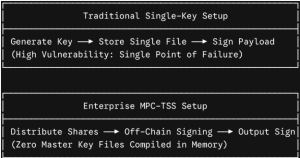
When authorizing an outbound transfer, the distributed nodes run an off-chain co-computation called a Threshold Signature Scheme (TSS). Each node calculates a localized partial signature using its isolated key share. These fragments are aggregated off-chain to generate a standard digital signature (such as ECDSA or EdDSA) that broadcasts to the blockchain ledger.
Key Architectural Advantages
- Eradication of Single Points of Failure: A master private key file never exists in system memory or disk storage at any point during its lifecycle.
- Neutralization of Key Extraction Risks: Compromising a single server, cloud environment, or executive device extracts nothing but a useless mathematical fragment.
- Native Multi-User Role Isolation: Allows corporate governance policies—such as approval hierarchies, daily volume caps, and spending rules—to map directly into key share clearance operations off-chain.
Core Operational Advantages of Enterprise MPC Wallets
Eliminating Single Private Key Exposure
If a complete, unified private key file sits on an employee’s laptop, an office hardware device, or a cloud server, it creates a static target. A single phishing attack, malware infection, or insider threat can compromise the entire treasury. Enterprise MPC wallets eliminate master key targets entirely. Even if an adversary compromises an internal endpoint, they cannot move funds without obtaining a quorum of isolated key shares.
Seamless Role-Based Governance for Enterprise Teams
Corporate cash management depends on multi-department oversight. Enterprise MPC platforms support customizable 基于角色的访问控制 (RBAC), allowing compliance teams to build granular approval hierarchies:
- Finance Clerks: Authorized to initiate payment requests and draft transactions.
- Compliance Officers: Review transaction details, run automated KYT address screening, and verify spending caps.
- Executive Approvers: Hold high-value key shares to grant final authorization for outlays crossing specific thresholds.
Granular Pre-Execution Transaction Protection
As blockchain transfers are irreversible, enterprise platforms incorporate active risk controls prior to transaction signature:
- Address Whitelisting: Restricts outgoing payments strictly to pre-vetted corporate accounts.
- Velocity Rate-Limiting: Enforces daily, weekly, or monthly caps on transaction volumes.
- Time-Lock Delays: Requires a mandatory cooling-off period for new recipient addresses or threshold overrides.
What Is Multi-Signature (Multi-Sig)?
Multi-Signature (Multi-Sig) is an on-chain authorization mechanism where a blockchain account or smart contract requires valid cryptographic signatures from multiple, independent private keys before executing a transfer.
Unlike a standard wallet controlled by one private key, a multi-sig configuration sets a direct threshold condition at the ledger layer—such as requiring a 2-of-3 or 3-of-5 approval quorum among designated co-signers.
Strategic Benefits of Multi-Sig
- Elimination of Single-User Control: No individual co-signer can unilaterally move funds or alter account parameters.
- Transparent Approval Pipelines: Transaction signatures are published directly to the blockchain explorer, providing an immutable audit log.
- Native Multi-User Execution: Aligns with collaborative structures, decentralized autonomous organizations (DAOs), and multi-party investment committees.
Technical Comparison: Enterprise MPC Wallets vs. On-Chain Multi-Sig
While both models eliminate single-person vulnerabilities, they manage security at fundamentally different layers of the technology stack:
| Operational Dimension | Enterprise MPC Wallets | On-Chain Multi-Sig Wallets |
| Private Key Status | Mathematically sharded at inception; master key never exists. | Uses multiple separate, complete private keys. |
| Execution Layer | Off-chain cryptographic multi-party protocols. | Public on-chain smart contracts. |
| Ledger Visibility | Clears as a standard single signature; internal structure stays hidden. | Approval structures, co-signers, and quorums are fully public on-chain. |
| Network Gas Fee Overhead | Fixed standard single-signature transaction cost. | Higher; transaction fees scale linearly with every added co-signer. |
| Cross-Chain Portability | Universal; natively compatible with all public blockchains. | Dependent on chain-specific smart contract capabilities and deployments. |
| Governance Customization | Dynamic; updated off-chain without changing the public wallet address. | Rigid; modifying rules requires smart contract calls or address migrations. |
Primary Enterprise Use Cases for Each Architecture
Optimal Use Cases for Enterprise MPC Wallets
- Institutional Hedge Funds & Asset Managers: High-value asset bases requiring fast, automated trade execution alongside strict, multi-tiered internal risk controls.
- Crypto Exchanges & Payment Service Providers (PSPs): High-concurrency operations processing thousands of automated deposits, customer withdrawals, and merchant settlements daily.
- Multi-Chain Enterprise Treasuries: Global corporations managing stablecoins and crypto assets across diverse Layer-1 protocols and Layer-2 rollups through a single interface.
Optimal Use Cases for On-Chain Multi-Sig
- DAO Treasury Governance: Decentralized organizations requiring transparent, on-chain voting and public verification of all capital outlays.
- Joint Venture Project Escrows: Strategic partnerships between separate corporate entities where funds must remain locked under explicit on-chain rules until pre-agreed conditions are met.
- Ecosystem Grant Programs: Web3 foundation funds distributing developer grants where public transparency outweighs transaction execution speed or operational privacy.
Strategic Evaluation Framework: Selecting the Right Architecture
When selecting an enterprise digital asset security solution, corporate risk officers should evaluate prospective systems across four primary dimensions:
1. Capital Scale and Operational Velocity
- High Volume / High Velocity: Organizations processing frequent transactions or managing large treasury reserves benefit from Enterprise MPC, which delivers fast execution speeds, low gas costs, and privacy for internal approval structures.
- Low Volume / High Transparency: Smaller teams or public organizations prioritizing ledger-level visibility over execution speed may find Multi-Sig sufficient for basic joint custody.
2. Corporate Governance and Approval Workflows
Ensure the system accommodates your actual corporate organizational chart. The platform should support custom role mapping (Initiators, Reviewers, Approvers), variable spending caps based on transaction value, and automated address whitelisting.
3. Multi-Chain Interoperability
If your corporate treasury manages assets across multiple blockchains, an MPC architecture provides universal compatibility out-of-the-box. Multi-Sig frameworks require deploying and auditing separate smart contract codebases for non-EVM chains, increasing ongoing development and maintenance overhead.
4. Risk Screening and Compliance Auditability
The solution must offer continuous Know Your Transaction (KYT) screening to automatically flag and block interactions with illicit addresses, sanctioned entities, or high-risk privacy mixers. Additionally, ensure the platform generates immutable, SOC 2-compliant audit logs for internal financial reporting.
Strategic Deployment: Institutional Infrastructure Powered by ChainUp
For institutions and Web3 enterprises seeking a platform that combines keyless MPC security with customizable enterprise governance, ChainUp 托管 provides an institutional-grade infrastructure.
The platform deploys a secure, non-custodial Multi-Party Computation architecture that eliminates single points of failure. By utilizing Threshold Signature Schemes (TSS), ChainUp Custody ensures cryptographic key shares are computed off-chain and never compiled in memory, delivering mathematically proven protection alongside fast settlement speeds.
At the same time, the platform features an advanced programmable policy engine. Corporate risk managers can set up multi-tier approval workflows, role-based access rules, destination address whitelists, and automated volume caps to match their exact internal governance controls.
Backed by authoritative international security credentials—including SOC 2 Type I & Type II, ISO/IEC 27001, ISO 27017, and ISO 27018—ChainUp Custody provides a compliant infrastructure supporting over 200 mainnet blockchains and thousands of token standards.
👉 Discover More: ChainUp 托管 Website
Upgrading Corporate Capital Protection
Relying on single-signature wallets or basic hardware storage is no longer an acceptable risk profile for modern corporate treasuries. Managing digital assets at an institutional scale requires a mature framework that balances technical security with operational efficiency and regulatory compliance.
Enterprise MPC wallets eliminate single points of failure at the cryptographic layer while preserving execution speed and operational privacy. On-chain Multi-Sig frameworks provide transparent, threshold-based execution suitable for public organization funds and joint venture escrows.
By deploying the right security architecture, modern enterprises can eliminate single-point vulnerabilities, enforce strict internal controls, and scale their digital asset operations safely and efficiently.