

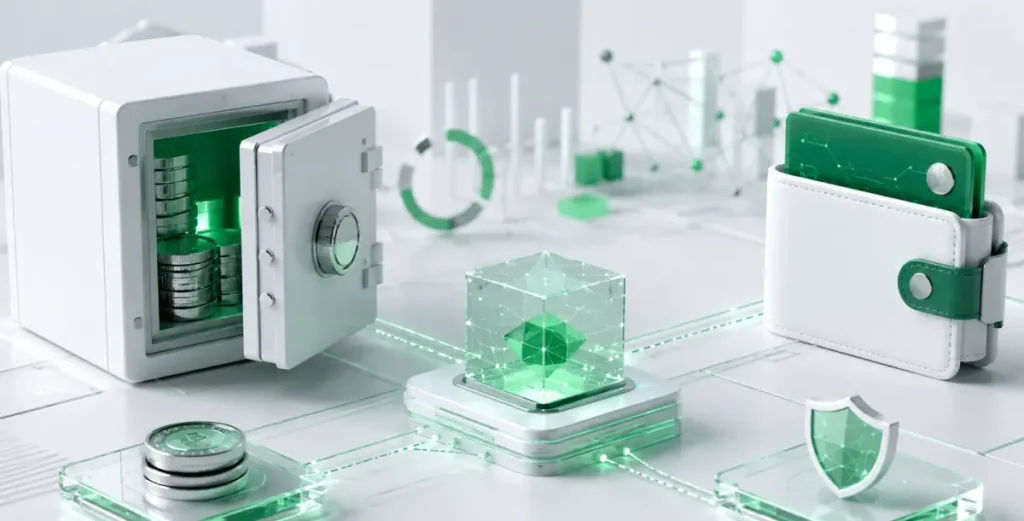
As institutional participation within the blockchain ecosystem scales, the infrastructure used to manage digital assets is undergoing critical standardization. Among the core components of this operational landscape, two distinct wallet architectures dominate executive discussion: Cold Wallets 及 Web3 Wallets.
Historically, these solutions have been framed as an either-or choice. In an institutional context, however, cold wallets represent the absolute benchmark for offline asset preservation, while Web3 wallets function as the operational interface required to interact with decentralized applications (dApps) and programmatic on-chain logic.
This technical guide deconstructs the underlying mechanisms, operational trade-offs, and risk profiles of both frameworks, detailing how enterprise treasuries can combine them into a unified, high-security governance architecture.
Cold Storage Architecture: Hardening the Air-Gapped Perimeter
A cold wallet refers to a storage architecture where the cryptographic private keys are generated, stored, and utilized inside an isolated ecosystem completely severed from any network connectivity. By maintaining a continuous air-gapped barrier, cold storage neutralizes remote network exploitation vectors.
Operational Cryptographic Workflows
The absolute security of a cold storage deployment relies on keeping private keys isolated from internet-exposed systems throughout their lifecycle. Execution follows a rigorous, asynchronous signing workflow:
- Air-Gapped Key Generation: Private keys and their associated public keys are generated locally within an isolated environment—such as a certified Secure Element (SE) chip on a dedicated hardware device or a permanently offline terminal.
- Public Address Export: The public keys or generated wallet addresses are exported to a network-connected environment via localized data transfers, such as QR code scanning, optical transmission, or single-use USB data packets. This public address is used externally to monitor treasury balances and receive incoming settlements.
- Offline Transaction Signing: When executing an outbound transaction, an unsigned transaction payload is constructed on an internet-connected device. This unsigned payload is transferred to the offline cold storage device. The private key signs the transaction inside the air-gapped environment, generating a cryptographically signed payload.
- Network Broadcasting: The signed payload is transferred back to the internet-connected device, which broadcasts it to the distributed ledger network. At no point are the private keys exposed to an online system or components running unverified code.
Core Institutional Benefits
- Immunity to Remote Exploit Vectors: Because the private keys never sit in memory on an internet-accessible device, they are shielded from advanced persistent threats (APTs), remote code execution (RCE) attacks, and network-level malware.
- Hardware-Level Verification: Enterprise-grade cold wallets feature isolated display screens and physical input buttons. This design allows operators to manually inspect and verify outbound addresses and transaction metrics before authorizing a cryptographic signature, mitigating local clipboard-hijack or address-substitution attacks.
- Long-Term Capital Preservation: Cold storage provides unparalleled security for reserve capital, institutional holdings, and long-term liquidity pools that do not require high-velocity movement.
Operational Constraints
- Friction and Reduced Agility: The multi-step, manual process required to sign transactions reduces operational velocity, making pure cold storage ill-suited for algorithmic market-making, high-frequency execution, or rapid capital deployment.
- Physical Attack Surfaces: Total reliance on physical media introduces risks associated with physical theft, supply-chain tampering, or localized disasters. Losing the underlying physical backup seeds without a robust multi-signature configuration results in catastrophic, permanent capital loss.
- Technical Onboarding Overhead: Successful implementation requires specialized internal operational workflows and continuous compliance training to ensure keyholders do not break air-gap protocols during standard operations.
Web3 Wallets: Engineering the Gateways to On-Chain Programmability
Web3 wallets are dynamic cryptographic interfaces designed to manage state interactions, execute smart contracts, and handle real-time interoperability across decentralized networks. Beyond simple asset transfers, Web3 wallets serve as a unified digital identity hub, substituting legacy authentication models (such as OAuth or centralized databases) with cryptographic public-key signatures.
Execution Mechanisms and Smart Contract Interoperability
A Web3 wallet bridges localized private keys with client-side dApp front-ends through standardized injection protocols (e.g., JSON-RPC providers).
When an institution engages with a DeFi protocol or asset tokenization platform, the dApp front-end transmits a structured transaction request or an arbitrary message signature request directly to the wallet interface. The wallet displays the parameters locally, allowing the operator to approve or decline the state change. Once confirmed, the wallet signs the payload and transmits it back to the protocol for network broadcast.
Primary Infrastructure Configurations
- Browser Extension Wallets: Injected directly into desktop browser environments, these utilities provide standard communication interfaces for dApps. They offer high agility for treasury teams interacting with multi-chain dApp ecosystems but carry higher exposure to browser-based vulnerabilities.
- Mobile Web3 Ecosystems: Dedicated mobile applications featuring sandboxed dApp browsers or integrated WalletConnect frameworks. These ecosystems often leverage mobile device biometric hardware (such as Secure Enclaves) to authorize transactions.
- Desktop Clients: Standalone software applications that offer advanced network configurations, direct node connections, and deep system logging. These clients are frequently used to interface directly with enterprise hardware wallets.
Operational Advantages
- Seamless Protocol Integration: Enables programmatic, multi-chain access to decentralized liquidity networks, real-world asset (RWA) tokenization layers, and complex smart contract functions within a unified user interface.
- Real-Time Transaction Simulations: Advanced Web3 wallets simulate state changes before signature execution, providing operators with clear visibility into token authorization adjustments, gas fees, and net balance impacts.
- Multi-Chain Asset Aggregation: Simplifies treasury operations by allowing teams to track, monitor, and deploy capital across disparate EVM and non-EVM layer-1 and layer-2 networks simultaneously.
Security Vulnerabilities and Attack Profiles
- Endpoint Vulnerability Profiles: Because Web3 wallet private keys are stored in software memory layers on internet-exposed endpoints, they are susceptible to memory-scraping malware, compromised browser extensions, and malicious operating system scripts.
- Complex Cryptographic Approvals: Operators routinely face social engineering and phishing attacks disguised as legitimate smart contract interactions. Attackers often trick users into signing malicious payloads, such as un-indexed approve or setApprovalForAll functions, which can drain a wallet’s address balances without compromising the underlying private key.
Architectural Matrix: Comparative Infrastructure Analysis
| Feature Set | Cold Wallet Infrastructure | Web3 Wallet Deployments |
| Private Key Lifecycle | Generated and maintained entirely offline within air-gapped environments. | Maintained in encrypted local storage on network-connected endpoints. |
| Primary Risk Vectors | Physical coercion, insider threats, and supply-chain degradation. | Phishing, malicious contract signatures, browser vulnerabilities, and malware. |
| Transactional Velocity | Low; requires deliberate physical data transfer and manual confirmation. | High; features near-instantaneous execution and automated signature flows. |
| Capital Allocation Optimization | Strategic reserve capital, long-term token holdings, and compliance custody. | Active operational capital, DeFi staking liquidity, and gas optimization layers. |
| Capital Cost Structure | Requires capital allocation for secure physical hardware and offline storage. | Free open-source or enterprise software tiers; costs scale with on-chain network fees. |
Hybrid Treasury Engineering: Harmonizing Security and Agility
For sophisticated corporate treasuries, choosing between cold storage and Web3 connectivity creates an inefficient operational bottleneck. Enterprise digital asset risk management is optimized by deploying a tiered, hybrid treasury model that combines both architectures.
1. Tiered Risk-Based Capital Allocation
Organizations should segment balance sheet assets into clear risk tiers based on liquidity velocity requirements:
- The Strategic Reserve Layer (Cold Storage): High-valuation, low-velocity core capital is isolated in distributed, multi-signature cold wallets. These funds are walled off from standard daily activities and remain undisturbed.
- The Operational Velocity Layer (Web3 Infrastructure): Low-valuation working capital and active operational funds are assigned to secure Web3 wallets. This structure grants the treasury team the agility to capture on-chain yield, settle immediate accounts, and handle daily operational expenses.
2. Hardware-Linked Web3 Interactions
To balance safety and convenience, organizations can connect physical cold storage hardware directly to Web3 wallet interfaces. In this configuration, the Web3 wallet acts as the visual layout and node-routing mechanism, while all transaction signing occurs inside the isolated hardware device. This setup allows the treasury to interact with sophisticated dApp ecosystems while ensuring that private keys never enter internet-exposed memory banks.
3. Automated Treasury Clearing Cycles
Establishing regular reconciliation protocols helps maintain a balanced treasury posture. Any profits, yield accruals, or surplus balances generated in high-velocity Web3 operational environments are systematically cleared and swept back into cold storage accounts at fixed intervals. This methodology limits total capital exposure to a predefined, acceptable operational threshold.
Strategic Implementation Framework
When deploying digital asset infrastructure, enterprise teams should prioritize the following core operational principles:
- Iterative Infrastructure Scaling: When onboarding teams to new digital asset systems, begin by deploying small capital allocations into sandboxed Web3 environments. This approach allows operators to build technical competency and validate internal standard operating procedures (SOPs) before scaling to high-security hardware cold storage setups.
- Enforcing Strict Key Generation Hygiene: Seed phrases and cryptographic backup parameters must never be converted into digital text. Backups should utilize non-digital, highly durable physical media (such as corrosion-resistant metal array plates) and be distributed across multiple secure corporate vaults to eliminate single points of failure.
- Granular Signature Policy Verification: Teams must treat every transaction approval as a distinct risk vector. Operators must carefully analyze execution simulations, verify contract logic origins, and reject ambiguous, blind-signing transaction payloads.
Building the Modern, Unified Wallet Infrastructure
The historical separation between offline isolation and online agility is steadily dissolving. Next-generation cold storage hardware is integrating advanced multi-party computation (MPC) frameworks and localized execution environments, allowing teams to isolate keys while maintaining real-time interaction capabilities. Simultaneously, institutional Web3 wallets are incorporating AI-driven transaction monitoring, automated counterparty risk scoring, and native account abstraction (ERC-4337) structures to automate corporate recovery paths and complex multi-user permission tiers.
Ultimately, cold wallets and Web3 wallets serve distinct roles within an institutional asset management framework. Cold wallets provide the necessary foundation for long-term risk mitigation and capital preservation, while Web3 wallets supply the network connectivity required to deploy assets across decentralized financial infrastructure. Combining both methodologies into a structured, risk-aware treasury system allows organizations to achieve maximum security without sacrificing operational performance.