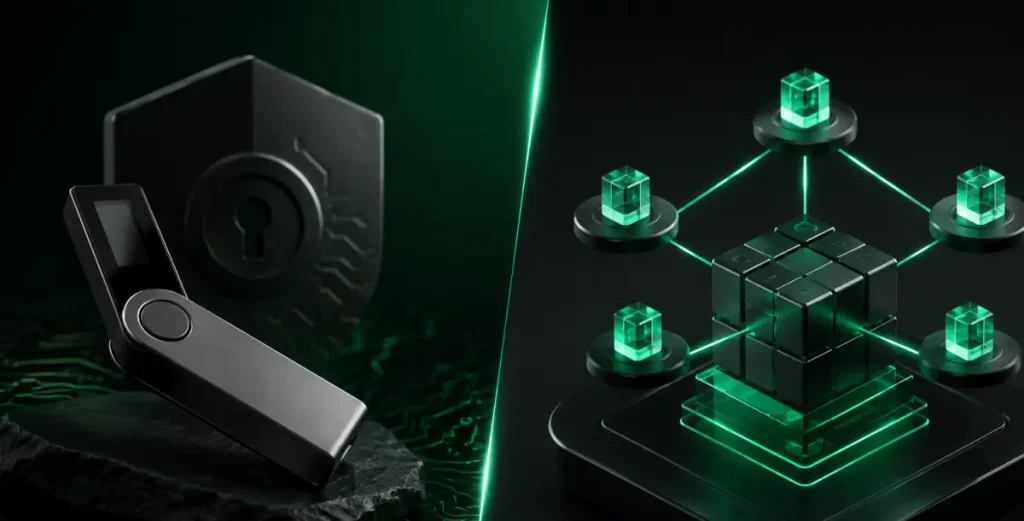


In the evolution of digital asset management, private key security has remained the most persistent pain point. Traditional wallet solutions have historically forced a compromise: either users assume total control (self-custody) or delegate complete trust to a third party (custodial wallets). Both paths often struggle to balance security with operational convenience.
In recent years, Multi-Party Computation (MPC) has emerged to break this deadlock. By introducing a new generation of wallet architecture, MPC allows for high-level security without the typical trade-offs. This article provides an in-depth analysis of MPC technical principles, core advantages, and how it fundamentally shifts the security paradigm of digital assets.
What is an MPC Wallet?
An MPC wallet is a digital asset management solution built on cryptographic multi-party computation. Unlike traditional wallets that rely on a single, unified private key, an MPC wallet mathematically splits the key into multiple “shards” or “shares.” These shards are distributed across different locations, devices, or stakeholders.
When a transaction requires a signature, the parties collaboratively compute the signature through a cryptographic protocol without ever needing to reassemble the shards.
The two defining features of an MPC wallet are:
- Distributed Key Integrity : The private key never exists in its entirety in any single location.
- Decentralized Signing: The signing process is a collaborative calculation rather than a centralized event.
Decentralizing the Private Key: The Mechanics of MPC
MPC is a subfield of cryptography that enables a group of participants to jointly compute a function over their inputs while keeping those inputs private.
In the context of a wallet, this “function” is the generation of a digital signature. Imagine a key split into three shards held by a user’s smartphone, a laptop, and a specialized service provider. When a transfer is initiated:
- No party learns the contents of another party’s shard.
- No single party can derive the full private key.
- Even if two parties collude, they cannot mathematically compromise the assets without the third shard.
- The resulting signature is identical to one produced by a standard private key, ensuring full blockchain compatibility.
Technical Comparison: MPC vs. Legacy Solutions
To evaluate the evolution of digital asset protection, the following table compares MPC against the three most common legacy storage architectures.
| Feature | Single-Key Self-Custody | Multi-Signature (Multi-Sig) | Traditional Custodial | MPC-Based Wallet |
| Key Location | Single device / Paper backup | Multiple distinct keys | Third-party server | Distributed shards |
| Point of Failure | Single (Key/Seed Phrase) | Multiple, but visible | Centralized (Counterparty) | Eliminated (Sharded) |
| On-Chain Privacy | High | Low (Structure is public) | Moderate | High (Standard signature) |
| Gas Costs | Standard | High (Multiple signatures) | Standard | Standard (Optimized) |
| Blockchain Support | 多链 | Varies by chain support | 多链 | 多链 |
| Account Recovery | Physical seed phrase only | Difficult/Manual | Identity-based | Threshold-based recovery |
Architectural Frameworks for MPC Integration
Depending on how shards are distributed, MPC wallets typically follow one of these frameworks:
- User-Led Model: All shards are controlled by the user but distributed across different devices (e.g., phone, laptop, and a hardware enclave). This eliminates the risk of a single device being lost or breached.
- Two-Factor (2FA) Model: The most common enterprise architecture. One shard resides on the user’s mobile device, while the other is held in a cloud-based secure environment. The provider cannot move funds alone, but they can facilitate account recovery and identity verification.
- Multi-Party Governance: Designed for institutional treasuries. Shards are distributed among key stakeholders (e.g., CEO, CFO, and Compliance Officer) with a set threshold (e.g., 3-of-5). This enables granular permissioning without the rigidity of on-chain multi-sig.
- Hybrid Disaster Recovery: Users control their daily shards but set a backup shard with a professional custodian. This shard is only activated for recovery after strict identity verification and a pre-set cooling-off period.
High-Level Institutional Security Models
MPC wallets offer several operational security benefits beyond simple storage:
- Elimination of Mnemonic Vulnerability: Because there is no “master key,” there are no 12-word seed phrases to be phished or lost. Recovery is handled through distributed shard reconstruction.
- Embedded Policy Engines: Advanced solutions allow for the embedding of rules (e.g., daily limits, whitelisting) directly into the cryptographic signing protocol. These are enforced at the protocol level and cannot be bypassed at the application layer.
- Proactive Risk Mitigation: Cloud-side shards can be programmed to verify transaction details against real-time risk parameters before participating in the signature process.
Deployment and Disaster Recovery Lifecycle
The user experience for an MPC wallet is designed to be as seamless as a traditional account while maintaining institutional security:
- Creation: Shards are generated locally and in the cloud simultaneously. The user typically secures their local shard via biometrics or a PIN.
- Execution: Transactions are signed in seconds via an encrypted communication channel between shards. The complexity of the cryptography is hidden from the user.
- Recovery: If a device is lost, the user can initiate a recovery process involving multi-factor authentication or “social recovery” via trusted contacts. The old shards are invalidated, and new shards are generated for the new device.
Defining the New Standard of Asset Control
MPC wallets represent a fundamental shift from “securing a secret” to “managing a distributed process.” By removing the reliance on a single, vulnerable private key, MPC provides a robust, scalable framework for the next generation of digital finance.
For institutional investors and high-net-worth individuals, MPC offers a “middle path” where security is distributed, responsibility is shared, and the user experience is fluid. As the industry moves toward more complex governance and regulatory requirements, MPC technology is positioned to be the foundational standard for secure asset management.