

As the digital asset ecosystem matures, the friction between security 及 usability has become a central challenge for both retail and institutional participants. Traditional private key management—relying on a single, fragile string of data—is increasingly viewed as a legacy risk. In response, MPC (Multi-Party Computation) Wallets have emerged as the definitive next-generation solution, fundamentally reimagining how we secure on-chain assets.
Redefining the Private Key: What is an MPC Wallet?
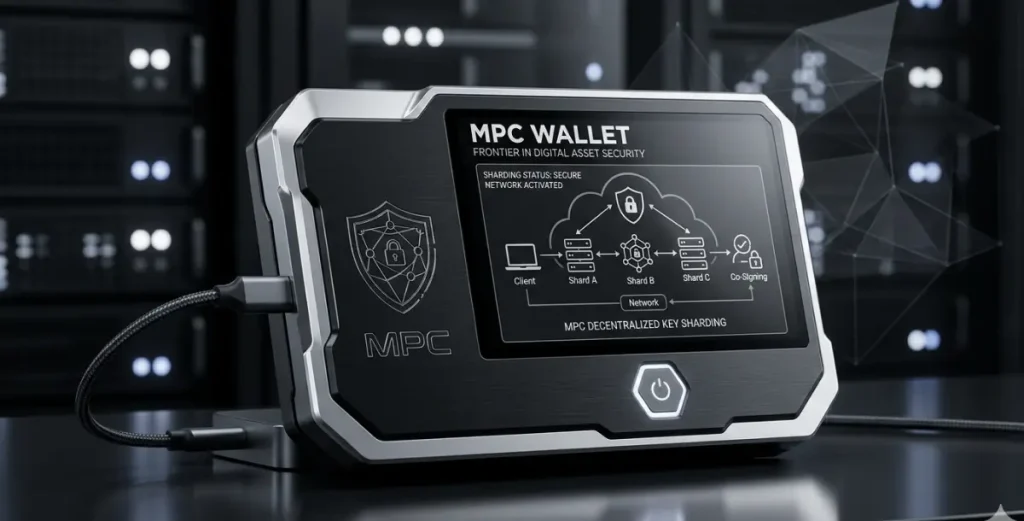
A Multi-Party Computation (MPC) wallet utilizes a sophisticated cryptographic framework to eliminate the “Single Point of Failure” inherent in traditional wallets. Unlike standard setups that rely on a single private key, an MPC wallet shards the key into multiple “Key Shards” (or fragments), which are distributed across distinct devices or parties.
In this model:
- The private key never exists in its entirety at any single location or point in time.
- Signatures are generated collaboratively through multi-party computation without ever reconstructing the full key.
- Resilience is built-in: Even if a specific device is compromised, the attacker cannot exfiltrate the assets because they only hold an unusable fragment.
Essentially, MPC shifts the security model from “Isolated Protection” to “Distributed Collaborative Defense.”
The Mechanics of Distributed Trust
The core of an MPC wallet is the Threshold Signature Scheme (TSS). The process follows a rigorous cryptographic lifecycle:
- Key Sharding: During wallet creation, the private key is mathematically split into fragments. No one—not the user nor the service provider—ever sees the “whole” key.
- Distributed Storage: These shares are scattered across isolated environments, such as a user’s smartphone, a secure cloud HSM (Hardware Security Module), or a dedicated recovery device.
- Collaborative Signing: When a transaction is initiated, the parties perform a distributed computation to generate a valid digital signature.
- Threshold Validation: The transaction is only broadcast to the blockchain once the pre-defined threshold (e.g., 2-out-of-3 or 3-out-of-5 shares) is met.
MPC vs. Multi-Sig: A Critical Distinction
It is common to confuse MPC with Multi-Signature (Multi-Sig) wallets, but the two are fundamentally different in their execution.
Multi-Sig operates at the protocol level (on-chain). It requires multiple independent private keys to sign a transaction. While secure, it is often more expensive (higher gas fees) and reveals the organizational structure of the signers on the public ledger.
MPC, by contrast, operates off-chain. To the blockchain, an MPC transaction looks like a standard single-signature transfer. This offers superior privacy, lower transaction costs, and greater flexibility, as the “signing logic” can be updated without changing the on-chain address.
The Strategic Advantages of the MPC Model
1. Eliminating the Single Point of Failure
By ensuring the private key is never fully assembled, MPC wallets defend against the most common attack vectors, including device theft, server breaches, and internal collusion.
2. A “Keyless” User Experience
One of the greatest barriers to Web3 adoption is the burden of the 12-word mnemonic seed phrase. MPC wallets allow for a more intuitive, “internet-native” experience. They support Social Recovery and biometric authentication (FaceID/Passkeys), making account recovery as simple as resetting a traditional banking password.
3. Institutional-Grade Governance
For enterprises, MPC allows for highly granular permissioning. Treasuries can implement complex approval workflows—such as requiring a CFO, a Compliance Officer, and an automated Risk Engine to all provide a “share” before a large-cap transfer is authorized.
Institutional and High-Net-Worth Applications
- Digital Asset Custody: Providing the backend infrastructure for exchanges and funds to manage billions in AUM without the risk of an internal “rogue actor.”
- Corporate Treasury: Enabling multi-user access to company funds with clear audit trails and automated risk caps.
- Web3 Onboarding: Serving as the gateway for DApps and decentralized exchanges (DEXs) to onboard non-technical users via familiar login methods.
Navigating the Challenges
Despite its advantages, MPC is a mathematically intensive field. The primary challenges include:
- Computational Complexity: The signing process requires multiple rounds of communication between parties, which can introduce slight latency.
- Connectivity Requirements: Because signing is collaborative, all participating “shares” must be online and able to communicate to finalize a transaction.
- Standardization: The industry is still converging on a unified MPC standard, meaning interoperability between different providers is currently limited.
The Future of Digital Sovereignty
The MPC wallet represents a pivotal shift in the digital asset stack. By replacing the “trust me” model of centralized platforms and the “high-stakes” pressure of self-custody with a distributed, collaborative framework, MPC provides the perfect balance of security and usability.
As institutional adoption accelerates into 2026, MPC will become the standard infrastructure for any entity serious about capital preservation. Whether you are an individual protecting a personal portfolio or an institution managing global liquidity, MPC technology offers the most resilient path forward in the digital economy.