
In the hierarchy of digital asset security, the industry often focuses on a binary choice: Hot Wallets for operational liquidity and Cold Wallets for high-security reserves. However, in professional practice, there exists a widely used yet frequently misunderstood middle ground: the Warm Wallet.
A warm wallet is not a specific product, but rather a security strategy that bridges the gap. It is more secure than a hot wallet (as it isn’t constantly exposed to network risks) and more accessible than a cold wallet (as it avoids the cumbersome manual procedures of air-gapped storage).
Tiered Asset Architecture: From Execution to Preservation
A mature digital asset management strategy typically utilizes a three-tier “Layered Defense” architecture to balance liquidity and risk.
| Tier | Purpose | Security Level | Connectivity |
| Hot Layer | High-frequency trading, daily payments. | Minimum | Always Online. Private keys reside in networked memory. |
| Warm Layer | Periodic settlement, liquidity rebalancing. | High | Controlled. Limited or intermittent network access. |
| Cold Layer | Long-term institutional reserves. | Maximum | Offline. Air-gapped; keys never touch a networked device. |
Warm Wallet Design: Integrating High-Velocity Liquidity with Governance
To achieve the “Golden Equilibrium,” a warm wallet must follow these four institutional-grade principles:
1. Controlled Network Connectivity
Unlike hot wallets that are “always-on,” warm wallets utilize restricted connectivity:
- Time-Windowed Access: The wallet only connects to the network during specific intervals (e.g., 10:00 AM – 11:00 AM) to process batch transactions.
- Signature Isolation: The device holding the private keys never directly connects to the public internet. It receives transaction requests via QR codes, Bluetooth, or dedicated local lines and returns only the signed data.
2. Rigorous Access Control
Warm wallets utilize a sophisticated governance layer to mitigate the risks associated with constant connectivity:
- Multi-Custodian Authentication: Accessing the physical device or authorizing a signature requires at least two authorized personnel (e.g., dual-biometric or dual-hardware keys).
- Stationary Hardware Hardening: The physical signing devices are tethered to monitored, high-security environments—such as dedicated server rooms or specialized safes—preventing unauthorized removal or physical tampering.
3. Transaction Policy Engine
Every transaction is scrutinized by an automated policy layer:
- Whitelisting: The wallet is restricted to sending assets only to pre-approved addresses. Adding a new address triggers a mandatory waiting period.
- Transactional Thresholds: Hard caps on single-transaction amounts and cumulative daily volumes.
- Time-Locks: Large transfers are delayed by 12–24 hours, allowing a “grace period” to cancel if a compromise is detected.
4. Automated Portfolio Management
The volume of assets in a warm wallet is dynamically managed. If the balance exceeds a set threshold, the excess is automatically pushed to cold storage. If it falls below a minimum, a request is sent to cold storage for replenishment.
Architectural Frameworks for Multi-Tiered Security
Hardware Security Modules (HSM) & Dedicated Hardware
For institutions, warm wallets are often powered by HSMs—enterprise-grade hardware designed to protect cryptographic keys. The HSM remains in a secure facility, connected only to a localized internal network. Transactions are pushed through an internal Enterprise Resource Planning (ERP) system for approval before reaching the HSM for signing.
Multi-Party Computation (MPC)
MPC provides a “Threshold” security model where a private key is never stored in one piece. Instead, the key is broken into independent shards and distributed across stakeholders like the CEO, CFO, and a secure server.
The “Warm” Effect refers to the ability to execute transactions quickly once a specific quorum (e.g., 2-of-3 shards) is reached. This architecture ensures no single party ever holds a full key, while “refreshing” the shards periodically renders stolen data useless for future attacks.
Cold-Hardware in a “Warm” Configuration
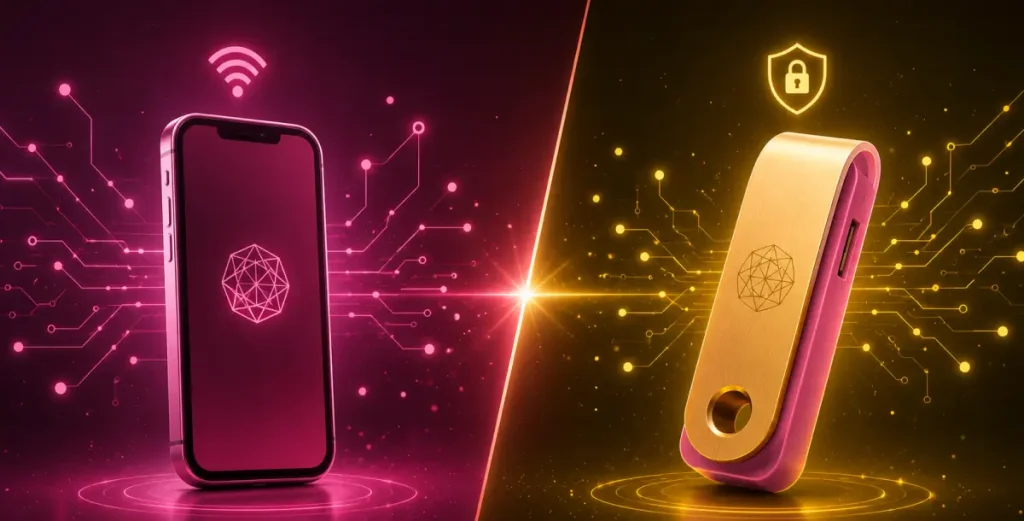
Small teams can use a standard hardware wallet (like Ledger or Trezor) as a warm wallet by keeping it in a safe but connecting it daily to process business-hour settlements. This uses “Cold” technology but follows “Warm” operational frequency.
Comparison: Why Choose a Warm Wallet?
| Feature | Hot Wallet | Warm Wallet | Cold Wallet |
| Risk of Hack | High (Remote) | Low (Controlled) | Near Zero (Air-gapped) |
| Operational Speed | Instant | Minutes to Hours | Hours to Days |
| Complexity | Low | Medium | High |
| Ideal For | End-users, Retail | Exchanges, Funds, Treasuries | Long-term Institutional HODL |
Strategic Governance: Standardizing Custody Protocols
To ensure institutional resilience, organizations should adopt a standardized deployment framework focused on governance and redundancy:
- Formalize Governance Documentation: Establish a comprehensive “Single Source of Truth” for all operational workflows. This includes mapping multi-signature approval hierarchies and defining explicit Business Continuity and Disaster Recovery (BCDR) protocols to mitigate key-person risk.
- Operational Readiness Drills: Execute quarterly stress tests and recovery simulations. These “fire drills” validate the efficacy of emergency asset extraction paths and ensure that authorized custodians are proficient in high-pressure execution environments.
- Converged Security Monitoring: Implement a holistic perimeter by integrating real-time on-chain transaction alerts with physical surveillance (biometric access logs and CCTV). This creates a unified defensive posture against both digital and physical threat vectors.
- Standardization via Audited Infrastructure: Avoid proprietary or experimental cryptographic implementations. Mandate the use of battle-tested, peer-reviewed MPC protocols and hardware certified to FIPS 140-2 Level 3 standards to ensure regulatory and technical compliance.
The Future of Institutional Asset Mobility
The transition toward tiered storage architectures signifies the maturation of digital asset management—moving from “binary” security models to a framework of nuanced risk orchestration. For organizations and their institutional partners, the warm layer is no longer a secondary consideration; it is the vital operational engine that ensures liquidity remains agile without compromising systemic safety.
By implementing a rigorous Tiered Capital Architecture—retaining core reserves in cold storage, maintaining operational working capital in the warm layer, and allocating minimal gas fees to the hot layer—enterprises build a resilient financial infrastructure. This strategic balance is the prerequisite for scaling safely in the institutional era of digital finance.