


As digital assets scale and corporate use cases diversify, security and compliance remain the core challenges of industry adoption. Multi-Signature (Multisig) technology offers a time-tested cryptographic approach to permission control, while crypto custody provides the institutional-grade framework needed to meet rigorous financial standards.
When these two elements fuse, they create a robust structure for digital asset storage, cash management, and clearing. Multisig breaks down single-user concentration risks through cryptographic checks and balances, while professional custody standardizes operations and automates compliance. Understanding this integration is essential for any enterprise, fund manager, or high-net-worth individual building a resilient corporate treasury.
What Is Multi-Sig? Cryptographic Separation of Powers Explained
Multisig was one of the earliest and most widely adopted security breakthroughs in the blockchain space. Its core philosophy is simple: eliminate the single point of failure inherent in traditional “one key, one wallet” designs by distributing operational control across multiple independent keyholders.
The Underlying Mechanics of M-of-N Thresholds
Multisig relies directly on public-key cryptography. Instead of a standard single-signature address, the platform compiles multiple unique public keys into a joint account governed by an M-of-N quorum rule. The account is linked to N total keys, but moving funds or executing a smart contract interaction requires a minimum of M valid signatures.
The lifecycle of a multisig transaction moves through three distinct phases:
- Setup and Rule Definition: The system gathers the public keys of all intended overseers, sets the signing threshold (M), and binds this logic directly into the blockchain protocol or a smart contract. Common configurations include 2-of-3, 3-of-5, or 4-of-7 structures. Once deployed, the address functions like any on-chain wallet but cannot bypass its native quorums.
- Transaction Initiation and Collection: Any authorized keyholder can initialize a transfer, generating a raw payload. This payload is passed to the other designated participants, who append their signatures using their isolated private keys. Crucially, co-signers only interact with their own key material, never exposing data to other endpoints.
- Validation and On-Chain Execution: Once the payload gathers the minimum required signatures (M), the aggregated data is pushed to the blockchain network. On-chain validators cross-reference the signatures against the pre-registered public keys. If the quorum is valid, the transfer clears on the ledger.
The Core Strategic Advantages and Operational Limitations of Multi-Sig
Crucial Security Benefits for Enterprise Teams
- Elimination of Strategic Target Risks: By distributing transaction clearing power, a breach at any single terminal or employee account yields nothing but an unusable mathematical shard. Rogue insiders or external hackers cannot unilaterally drain the treasury without compromising the entire threshold.
- Granular Organizational Control: Governance parameters can be customized to mirror actual corporate management. Teams can create hierarchical rules, such as using low-threshold single signatures for routine operational cash flows while requiring executive quorums for high-value allocations.
- Native On-Chain Transparency: As every approval is recorded directly onto the public ledger, internal compliance teams and external auditors have an unalterable paper trail detailing exactly who authorized every transfer.
Understanding the Practical Boundaries of Multi-Sig
While multisig delivers exceptional structural defense, it introduces specific operational frictions:
- Processing transactions through multiple individual endpoints extends the execution timeline, making multisig a poor fit for ultra-low-latency high-frequency trading.
- Adjusting approval rules or changing corporate signers usually requires creating a brand-new blockchain address and manually migrating assets, creating technical friction.
- It remains a pure permission tool; it does not replace the need for comprehensive firewalls, automated anti-money laundering (AML) screening, and around-the-clock infrastructure monitoring.
What Is Crypto Custody? Institutional Asset Management Platforms
Digital asset custody adapts traditional financial safekeeping to the unique requirements of public ledger networks. Instead of managing physical securities, crypto custody is an integrated service model providing secure asset storage, automated internal control tracking, and regulatory compliance for corporate treasuries.
Evaluating the Primary Custody Service Architectures
- Third-Party Custody: Highly regulated, independent institutions that store client capital completely segregated from the custodian’s own balance sheet. This serves as the primary standard for asset managers and listed corporations.
- Proprietary Self-Hosted Custody: Large enterprise organizations deploying dedicated, custom-built internal infrastructure to maintain absolute control over their keys and data environments.
- Consortium Custody: Shared network frameworks where key material is distributed across separate institutional partners, requiring multi-firm agreement to clear capital.
Institutional Value and Functions of Qualified Custodians
- Bank-Grade Infrastructure: Custodians isolate master keys using a combination of air-gapped cold storage, distributed key management, physical security perimeters, and 24/7 technical monitoring that far exceeds individual corporate IT capabilities.
- Turnkey Regulatory Alignment: Compliant custody platforms build automated identity checks (KYC), transaction monitoring (AML), and standardized auditing exports directly into the system, shielding corporate clients from regulatory exposure.
- Flexible Corporate Guardrails: Platforms package raw technical parameters into intuitive administrative dashboards, enabling treasury managers to build custom approval workflows, mandate destination whitelisting, and set daily volume caps.
- Insurance and Loss Indemnification: Regulated providers protect client reserves with dedicated insurance capital and structural reimbursement clauses to hedge against security incidents—a critical buffer that self-managed setups lack.
The Fusion Layer: Integrating Multi-Sig into Enterprise Custody
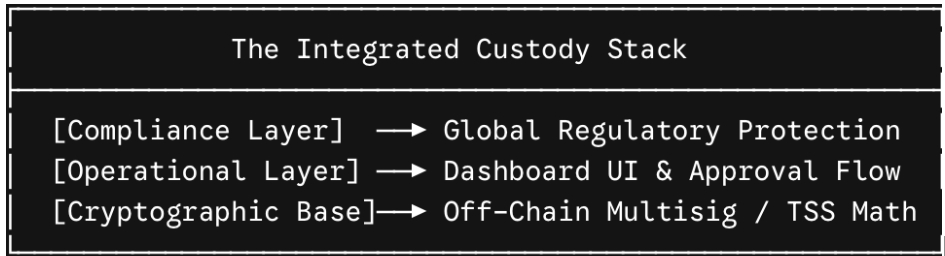
Multisig and professional custody are not competing concepts; they are deeply complementary layers. Multisig provides the foundational off-chain cryptographic logic, while institutional custody delivers the operational framework, user interfaces, and compliance guardrails needed to make it usable at scale.
Addressing the Trust Paradox
By building custody frameworks on top of multisig tech, institutions eliminate counterparty trust issues. Keys can be distributed directly between the client, the custodian, and an independent third-party auditor. This ensures the custodian can never mismanage or freeze capital unilaterally, while guaranteeing the client has a resilient, multi-sign path to access funds.
Enterprise Use Cases: Multi-Sig Custody in Action
Institutional Asset Allocation and Fund Management
Banks, family offices, and investment managers deploy integrated multisig custody to manage client capital safely. This setup splits transaction clearance among portfolio managers, compliance risk officers, and independent clearers, ensuring every trade passes internal corporate policies before hitting the ledger.
Crypto Exchange Infrastructure and Capital Isolation
Trading platforms use multisig custody to enforce strict segregation between platform operating capital and retail user deposits. By routing reserve pools through multi-department, geographically separated signing nodes, exchanges can neutralize the risk of internal employee fraud and secure automated hot nodes from external hacks.
Global Treasury Governance for Enterprises
Large corporate conglomerates use these platforms to coordinate cash operations across multiple regional business lines. Head offices can implement tiered threshold policies, giving local subsidiaries the agility to execute routine payments while keeping high-value treasury movements under central corporate approval loops.
How to Evaluate and Choose an Enterprise Custody Solution
When selecting or designing a multisig custody model for your business, focus on four main operational parameters:
- Cryptographic Resilience: Verify that the underlying code uses mature, fully audited signature algorithms. Ensure that key generation loops are decentralized and avoid static master key dependencies.
- Quorum Configuration Logic: Design your M-of-N configurations around your actual corporate structure. Use odd-numbered participant pools (e.g., 3-of-5) to prevent deadlocks, and implement backup recovery lines to handle potential node losses or team transitions.
- Regulatory and Compliance Pedigree: Prioritize partners that maintain registered fiduciary statuses, clear compliance records, and independent security credentials (like SOC2 or ISO 27001 certifications) within your primary operating jurisdictions.
- Workflow and Interface Compatibility: The software platform should blend smoothly with your existing accounting perimeters, supporting custom role permissions, granular value filters, and automated balance sheets that save time for your finance team.
Balancing Settlement Agility with Structural Safety
Public keys and multisig protocols are essential components of a robust, modern digital asset strategy. While public keys deliver the cryptographic baseline for identity verification and transaction validation, multisig structures transform asset safety by replacing single points of failure with distributed authority.
For individual retail users, understanding public keys simply helps navigate basic account movements. However, for institutional teams and modern enterprises, deploying a multisig architecture is a structural requirement for business continuity. As global Web3 markets scale, combining these cryptographic pillars with comprehensive risk frameworks will remain the standard foundation for securing digital wealth.
Disclaimer: This content is for informational and educational purposes only and does not constitute technical configuration, product selection, or investment advice. Always conduct comprehensive internal security audits and professional risk assessments before deploying advanced cryptographic infrastructure.