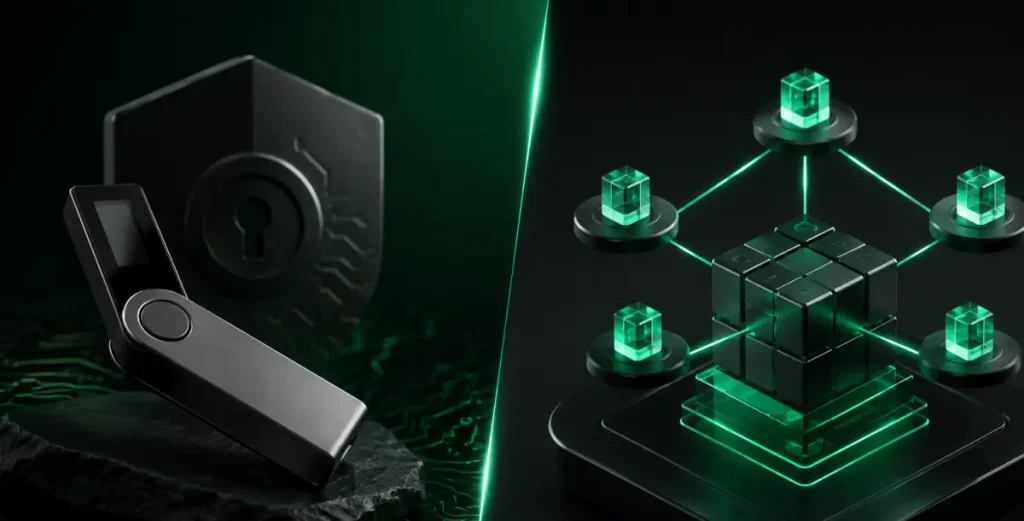


As decentralized finance, NFTs, and on-chain dApp ecosystems experience massive growth, Web3 wallets have evolved from a niche technical tool into the main entry point for hundreds of millions of users entering the blockchain world. However, as the user base expands, structural challenges around private key management, user experience, and transaction safety have become highly visible.
The integration of Multi-Party Computation (MPC) is rewriting the security boundaries of Web3 wallets directly at the cryptographic layer. This guide explores the evolutionary path of Web3 wallets, the mechanics of MPC, and how this combination is stabilizing the future of the decentralized web.
The Blueprint and Evolution of Web3 Wallets
To evaluate the impact of Web3 wallets, it helps to understand how they differ from traditional payment setups. Traditional wallets are simply visual dashboards for bank accounts, where ultimate asset custody remains with a centralized financial institution.
On the other hand, a Web3 wallet is an engine built to manage cryptographic key pairs. The public key forms your on-chain address, while the private key is your unique title deed used to sign transactions and verify digital identity.
Private Key⟶Cryptographic Signature⟶Absolute On-Chain Control
Holding the private key means owning the asset. While this return of data sovereignty grants absolute personal control, it introduces significant risk: if a private key is leaked or lost, the funds are permanently bricked, and there is no centralized recovery desk to reverse the damage.
The Phased Evolution of Wallet Architecture
- Software Hot Wallets: Early Web3 adoption relied heavily on sandboxed browser extensions and mobile apps where keys were encrypted locally. Account recovery depended on a manual seed phrase (a string of 12 or 24 words). This design placed a crushing personal liability burden on individual holders—requiring them to store phrases offline, avoid digital screenshots, and protect backups from remote hacks. In practice, this proved highly prone to human error.
- Hardware Cold Wallets: Cold storage tokens emerged to engineer out online attack surfaces by locking private keys inside an isolated physical chip. While hardware isolation delivers top-tier protection, the physical friction of manual transaction approvals, the risk of device loss, and steep onboarding curves kept it as a specialized tool for power users rather than a mass-market utility.
- Smart Contract Wallets (Account Abstraction): On-chain programmable accounts introduced advanced features like social recovery loops and customizable user permissions. However, intense smart contract auditing overhead, cross-chain deployment complexities, and linear network gas fee increases created major adoption barriers.
This friction paved the way for MPC wallet architecture, a framework designed to eliminate single private key vulnerabilities altogether off-chain.
Cryptographic Foundations: The Threshold Mechanism
Multi-Party Computation is an advanced subfield of cryptography created in the 1980s to solve a classic math challenge: How can multiple independent participants jointly execute a calculation using private data inputs without ever exposing those inputs to one another?
In the digital asset space, this logic translates directly to a practical problem: How can separate nodes co-sign a blockchain transaction without a complete private key ever existing on any single machine?
Modern MPC configurations achieve this by pairing the protocol with a Threshold Signature Scheme (TSS). During account generation, the core private key is mathematically split at inception into independent fragments called key shares, with each participant holding a single piece.
When a transaction requires signing, the required threshold nodes run localized calculations directly on their isolated shards to generate partial signatures. These mathematical pieces are compiled off-chain to produce a standard single signature that clears on the blockchain network.
The defining feature of this tech stack is that a complete, unified private key file never exists anywhere in device memory throughout the asset lifecycle. It is generated distributedly, aggregated off-chain, and verified natively.
Shifting the Architecture from Centralized to Distributed
Applying Multi-Party Computation to Web3 wallets is not an incremental software patch; it is a structural shift in how digital perimeters are secured.
Breaking the Single Target
The primary vulnerability of traditional self-custody is its static concentration. Whether a private key sits on a piece of paper, a hardware token, or an individual’s device, it exists as a single, complete string of data at some point in time—forming a clear single target for attackers.
MPC shatters this attack surface. In a typical two-party deployment, the user’s endpoint terminal holds one share, and a secure infrastructure server holds the second. If an adversary compromises the user’s laptop, they only extract an incomplete data shard that cannot authorize a transaction. If they breach the cloud server, the target yields no usable capital. An attacker must coordinate simultaneous, highly sophisticated exploits across entirely separate security perimeters to move funds, exponentially raising the economic cost of an attack.
Dynamic Shard Refreshing
MPC introduces a security layer known as Proactive Secret Sharing (PSS). This allows the distributed nodes to automatically recalculate and refresh the mathematical value of all key shares at scheduled intervals—all without altering the public key or changing the underlying on-chain blockchain address. Even if an adversary successfully scrapes an isolated share during a network breach, that share automatically becomes useless after the refresh window closes, giving attackers a negligible exploit timeline.
Streamlining the Daily User Experience
From a retail usability perspective, MPC brings the fluid onboarding of traditional Web2 apps into the Web3 space. Users no longer need to write down 24 recovery words or carry physical hardware tokens to ensure security. The threshold co-signing loops process transparently in the background, matching the responsiveness of standard mobile banking apps while retaining enterprise-grade protection.
Key Commercial and Ecosystem Applications
Decentralized Finance Optimization
Active DeFi participants interact continuously with liquidity protocols—authorizing spending caps, staking tokens, and managing multi-chain liquidity pools. Traditional wallet designs require users to inspect every smart contract signature manually, leaving them highly exposed to front-end phishing tricks. MPC engines allow developers to integrate compliance filters directly into the off-chain co-signing loop, screening contract addresses and transaction velocities before passing payloads to the key shares.
Institutional Treasury Governance
For corporate asset managers, crypto funds, and decentralized organizations, MPC serves as a native risk management hub. Traditional multi-sig wallets offer structural split-control, but they expose corporate management structures on public block explorers and incur heavy network gas fees. MPC handles multi-user approvals off-chain, ensuring transactions present on the ledger as standard single signatures, preserving corporate operational privacy.
High-Velocity Web3 Gaming and Social Platforms
Mainstream consumer applications require frictionless execution. Forcing a Web3 mobile gamer to manually approve a pop-up signature for every single on-chain action ruins the user experience. MPC wallets can be paired with session keys, allowing players to authorize pre-set, automated transaction boundaries safely, providing smooth, uninterrupted gameplay without lowering their core treasury defense parameters.
Technical Comparison: Mapping the Wallet Spectrum
To choose the right security model, teams must evaluate how different wallet form factors handle structural trade-offs.
| Comparison Metric | Legacy Software Wallets | Hardware Cold Storage | On-Chain Multi-Sig | Non-Custodial MPC |
| Primary Backup Mechanism | Manual 12-24 word seed phrase. | Physical paper or metal seed sheet. | Multi-account smart contract code logic. | Multi-factor, multi-device shard restoration. |
| Vulnerability to Remote Attack | High; exposed to local malware and phishing. | Zero; protected by strict air-gapped isolation. | Low; protected by separate private key rules. | Zero Single Point; requires multi-endpoint breach. |
| Transaction Processing Velocity | High; instant online signing. | Slow; requires manual hardware click inputs. | Slow; dependent on multi-step on-chain confirmations. | High; real-time off-chain threshold calculations. |
| Network Gas Cost Efficiency | Standard network single-signature baseline. | Standard network single-signature baseline. | High; increases linearly with every added signer. | Standard network single-signature baseline. |
Current Technical Challenges and Development Horizons
Despite its strategic advantages, implementing an enterprise MPC architecture requires managing specific technical trade-offs:
- The Interoperability and Standardization Gap: The current MPC ecosystem is highly fragmented. Multiple providers utilize varying implementations of Threshold Signature Schemes (such as different variations of GG18, GG20, or CMP protocols), causing a lack of unified industry standards. This makes it difficult to migrate key shares cleanly across separate wallet providers without manual friction.
- Network Performance Dependencies: As MPC requires distributed nodes to communicate over a network connection to compile partial signatures, execution speed relies on stable internet routing. Under high network latency or severe server congestion, signing confirmations can lag behind standard local single-key signatures.
- Share Lifecycle Management: While engineering out seed phrases streamlines onboarding, users must still be guided through concepts like shard backup tracks, rotation intervals, and social recovery setups. Minimizing this cognitive burden remains an ongoing UI/UX development challenge.
The Long-Term Cryptographic Roadmap
The development roadmap is moving toward the deep integration of Multi-Party Computation with Account Abstraction (ERC-4337). Rather than competing architectures, they function as perfect structural complements: MPC manages secure, distributed off-chain key storage, while Account Abstraction handles on-chain flexibility like automated daily spending parameters and native gas fee sponsorships.
At the same time, combining MPC with Zero-Knowledge Proofs (ZKPs) will enable advanced privacy-preserving authentication, allowing wallets to function as secure, auditable, and self-sovereign digital identity portals for the global web.
The history of wallet architecture is a continuous effort to align institutional safety with everyday usability. By turning the private key from a static target into an active, distributed cryptographic protocol, Multi-Party Computation eliminates the structural trade-off between absolute protection and transaction agility.
When security no longer requires dealing with physical hardware friction, and everyday users can access the same protective perimeters as professional treasuries without manual complexity, the blockchain ecosystem achieves a scalable foundation for mass adoption. MPC wallets are transforming the entry point to the decentralized network, making it significantly more secure and accessible for the next generation of global finance.
Disclaimer: This content is for informational and educational purposes only and does not constitute financial, investment, or operational advice. Managing digital assets involves high risk; always conduct thorough internal risk assessments before deploying any security infrastructure.