

As the digital asset ecosystem matures, institutional participants, Web3 enterprises, and financial intermediaries face growing complexity in asset preservation, granular permissioning, and real-time risk mitigation. Legacy single-private-key architectures are insufficient for institutional operations, which demand high throughput, ironclad security, and collaborative workflow management.
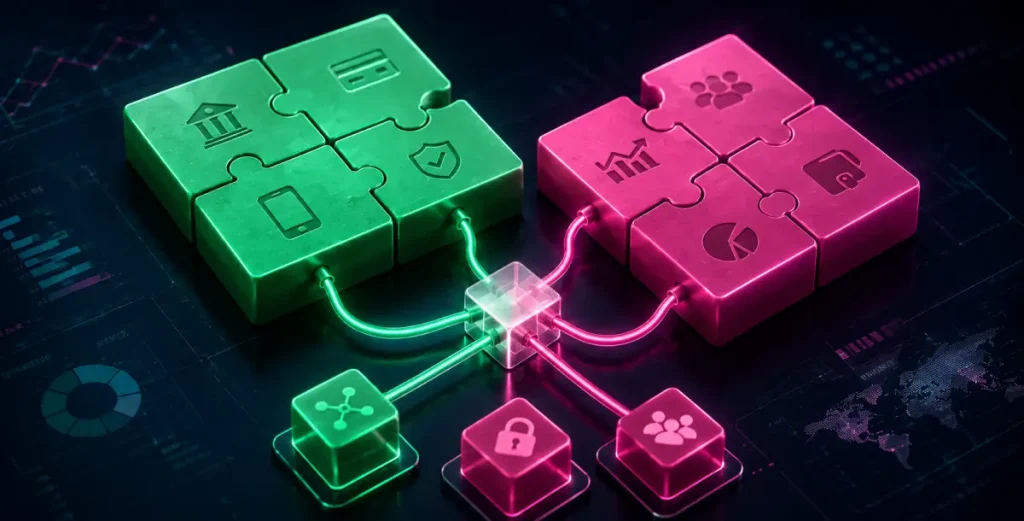
To address these challenges, enterprise infrastructure is shifting toward a hybrid paradigm: Multi-Party Computation (MPC) coupled with Multi-Signature (Multi-Sig) governance frameworks.
Whether deploying automated payment rails, structuring exchange liquidity pools, or managing corporate treasury reserves, enterprises use MPC and Multi-Sig mechanics to balance operational velocity with institutional security controls. This analysis explores the technical architecture, operational advantages, and enterprise deployment models of this next-generation digital asset security infrastructure.
Deconstructing MPC and Multi-Signature Mechanics
While both concepts distribute operational authority across multiple parties, they operate at fundamentally different layers of the technology stack.
Cryptographic Infrastructure: Multi-Signature (Multi-Sig)
Multi-Sig is a native protocol-level smart contract or script configuration that requires authorization from multiple independent private keys before a transaction can be executed on-chain.
For instance, in a 2-of-3 Multi-Sig arrangement, three unique private keys are generated and assigned to separate participants. A valid ledger transaction requires at least two distinct cryptographic signatures. This structural configuration eliminates single-operator vulnerabilities and mitigates internal collusion risks. However, because every signature must be written to the blockchain, Multi-Sig operations carry higher data fees (gas costs) and expose internal governance structures to public ledgers.
Cryptographic Infrastructure: Multi-Party Computation (MPC)
MPC is an off-chain cryptographic framework based on distributed key generation (DKG). Instead of producing multiple complete private keys, an MPC protocol generates a single mathematical private key that exists solely as separate, isolated key shards.
These shards are distributed across independent network nodes or user endpoints. When a transaction requires approval, the nodes execute a distributed signing protocol to construct a standard on-chain signature.
Throughout this lifecycle, the complete private key is never assembled, viewed, or exposed in any memory environment. Compromising a single node yields no actionable data, providing structural resilience against external exploits.
Comparative Analysis: Technical Differences
| Operational Parameter | Native Multi-Signature (Multi-Sig) | Multi-Party Computation (MPC) |
| Key Architecture | Multiple complete, independent private keys. | A single mathematical key divided into isolated shards. |
| Ledger Footprint | Explicitly visible on-chain via smart contract state. | Indistinguishable from a standard single-signature address. |
| Execution Layer | On-chain execution (smart contract or native script). | Off-chain execution via cryptographic protocol. |
| Transaction Fees | Scales linearly with the number of required signers. | Fixed, identical to standard single-signature network costs. |
| Operational Agility | Rigorous; modifications require on-chain contract updates. | Highly flexible; thresholds can be updated off-chain via shard rotation. |
Operational Advantages of Combined Architectures
Integrating the off-chain mathematical security of MPC with the definitive policy layer of multi-party governance gives enterprises an agile, secure environment tailored for high-volume operations.
Defense-in-Depth Asset Security
The primary vulnerability of legacy digital asset infrastructure is private key exposure. The integration of MPC shards with multi-party operational workflows addresses this risk. Even if an adversary compromises a production server or extracts an employee’s local authentication credentials, they cannot unilaterally move funds.
To execute an unauthorized transaction, an attacker must compromise multiple isolated endpoints and infrastructure boundaries concurrently, significantly increasing the resource cost and sophistication required for an exploit.
Granular Permissioning and Corporate Governance
Enterprise operations require multi-tiered approval chains, risk-assessment checkpoints, and cross-departmental coordination. Hybrid MPC architectures allow organizations to build customizable approval matrices that mirror corporate hierarchies:
[Transaction Initiator] —> [Risk Engine Validation] —> [CFO Approval Node] —> [MPC Signature Broadcast]
This structural logic supports complex organizational requirements, including corporate treasury management, institutional custody setups, and decentralized governance (DAO) frameworks.
Optimized Throughput and Operational Velocity
Traditional cold-storage mechanisms rely on manual workflows, offline signing hardware, and physical interventions that introduce significant operational friction.
In contrast, enterprise-grade MPC frameworks support programmatic execution through secure API integrations, automated compliance reviews, and automated internal transfers. This architecture allows treasury managers to enforce strict internal governance without sacrificing the transaction speeds required by programmatic trading desks and real-time settlement networks.
Reduced Overhead and Enhanced Data Privacy
Because traditional Multi-Sig systems require multiple individual signatures to be verified directly on-chain, they incur higher gas costs and display internal organizational structures on public ledgers.
An MPC-driven framework resolves these inefficiencies by executing the multi-party signing process entirely off-chain. The network sees only a standard, single-key transaction, reducing transaction fees and keeping internal corporate workflows private.
Enterprise Deployment and Application Scenarios
Institutional Asset Management and Prime Brokerage
Corporate treasuries and asset managers require multi-account management structures, clear audit trails, and rule-based risk parameters.
Advanced MPC configurations allow compliance officers to implement automated security boundaries, such as transaction velocity ceilings, mandatory destination whitelisting, and dual-authorization policies for institutional-tier fund transfers.
Web3 Infrastructure and Smart Contract Interaction
High-velocity decentralized applications, Automated Market Makers (AMMs), and oracle networks require high-frequency on-chain interactions that traditional hardware architectures cannot sustain.
MPC protocols support automated transaction signing, secure programmatic integrations, and dynamic permission shifts, making them critical infrastructure components for institutional Web3 applications.
High-Volume Digital Asset Settlement and Payment Rails
Commercial payment processing demands high availability, concurrent transaction handling, and secure settlement paths.
Distributed MPC node architectures allow payment platforms to automate fund aggregation and client distributions via highly available network nodes, eliminating single-point-of-failure vulnerabilities at the infrastructure layer.
Enterprise Technical Architecture
A resilient institutional digital asset platform integrates five core operational layers:
- Key Management Layer: Manages Distributed Key Generation (DKG), shard isolation, and hardware-level encryption (such as TEE/SGX environments), ensuring full cryptographic confidentiality throughout the key lifecycle.
- Distributed Signing Engine: Orchestrates multi-node cryptographic computations, verifies mathematical thresholds (t-out-of-n), and compiles valid transaction signatures off-chain.
- Role-Based Access Control (RBAC): Manages user permissions, structures multi-signature approval tiers, and enforces organizational governance rules before launching cryptographic processes.
- Real-Time Risk Engine: Evaluates transaction risk profiles against rule sets, including destination address validation, value thresholds, and behavioral anomaly detection.
- Audit & Compliance Engine: Generates immutable transaction records, tracks administrative activities, and provides forensic logging to meet global compliance and reporting obligations.
Resolving Operational Risks for Institutional Treasuries
- Mitigating Internal Exploits: By enforcing decentralized governance thresholds, no single executive, administrator, or systems engineer can unilaterally move or expropriate enterprise digital asset reserves.
- Eliminating Systemic Infrastructure Failure: Traditional wallet storage keeps operational access bound to an individual physical key or seed phrase. Distributed MPC architectures mitigate this risk by spreading cryptographic parts across geographically separate infrastructure environments.
- Driving Programmatic Automation: Modern digital asset platforms must scale efficiently. Enterprise-grade MPC integrations connect directly with core financial applications, letting developers automate accounting adjustments, fund pooling, and clearing operations without bypassing governance rules.
Strategic Technology Trajectories
- Unified Multi-Chain Management: As capital continues to distribute across distinct layer-1 networks and layer-2 scaling solutions, enterprise infrastructure must offer native multi-chain support. Modern MPC protocols allow organizations to use a single distributed shard configuration to secure assets across different cryptographic curves (such as ECDSA and Ed25519).
- AI-Enhanced Risk Mitigation: The next generation of enterprise wallets will integrate machine-learning risk models directly into the compliance layer. These engines analyze transaction behaviors in real time, score smart contract interactions, and dynamically adjust authentication thresholds based on real-time threat landscapes.
- Cloud-Native Sovereign Deployments: High-availability financial systems require resilient infrastructure. Enterprises are increasingly shifting toward cloud-native MPC deployments, leveraging geo-distributed hardware security modules (HSMs) and redundant node topologies to guarantee uptime and business continuity.
Redefining Institutional Digital Asset Infrastructure
The evolution of digital asset management is defined by the continuous optimization of security architecture. The transition from vulnerable single-private-key solutions to protocol-level Multi-Sig, and now toward hybrid MPC-driven frameworks, reflects an industry maturing toward institutional-grade standards.
For enterprises, digital asset service providers, and institutional investors, adopting an MPC-enabled multi-party signature architecture is more than an operational upgrade—it establishes a robust foundation for secure, compliant, and scalable digital asset operations.